Chapter I: The Dream of the Milky Ocean
As the first echoes of the Manifesto of the Discrete Rebellion faded in the dungeons of the capital, the Adult Children faced the most difficult task in their history. They had to embark on a journey through the Ten Trials of the Cosmos, and the first of these led to the very frontiers of the grand scale—there where the ancient sages expected to find an absolute, nearly divine tranquility.
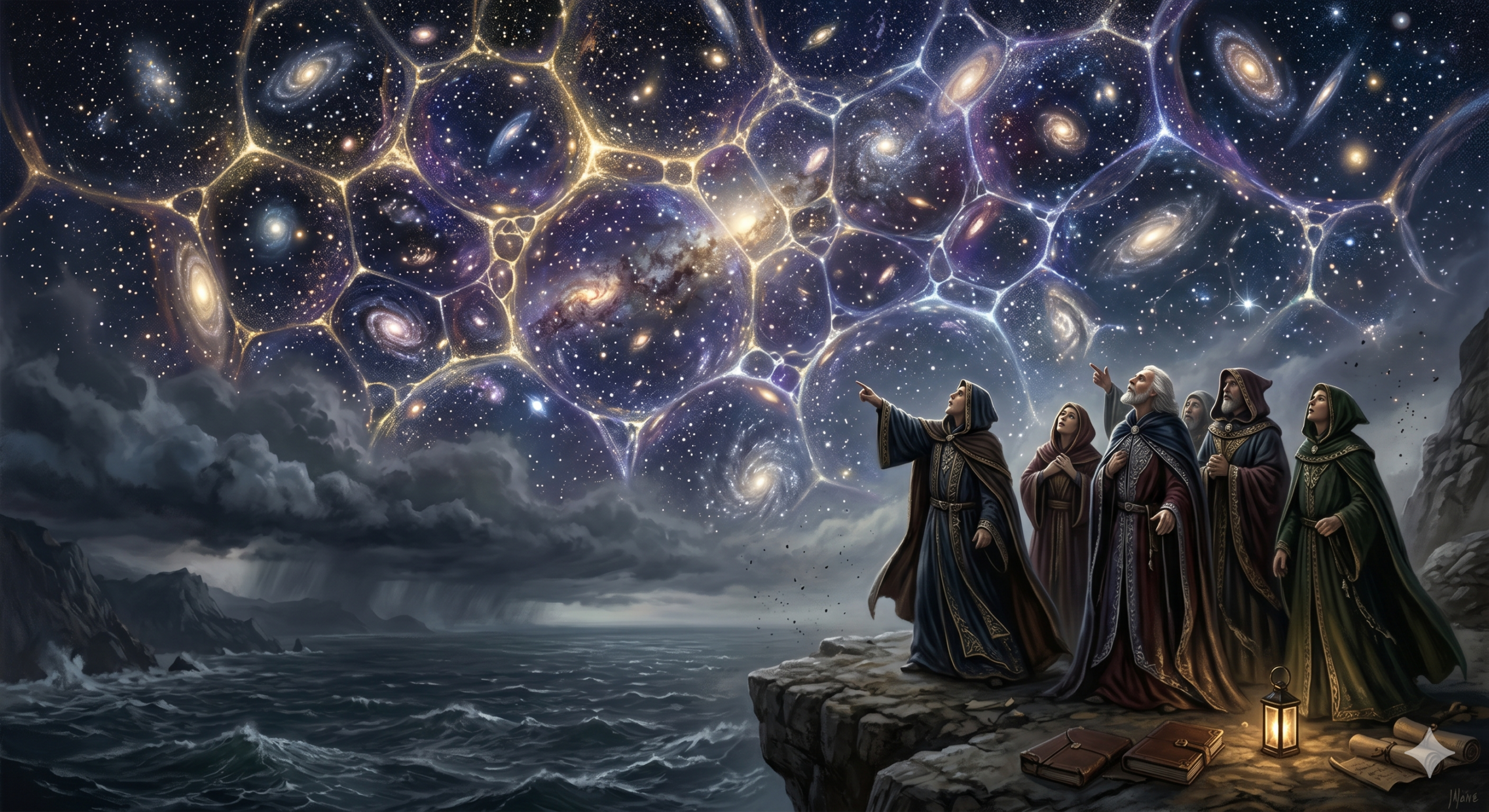
For centuries, in the Empire of Fluid Delight, it was believed that if one traveled far enough from individual worlds and looked upon the Universe from the perspective of the gods, all matter would appear as a perfectly homogeneous, smooth cloud. The court professors, invoking the heritage of Master Albi, taught in the academies that cosmic gold and silver were distributed across the Cloak as evenly as milk pours into a proper farmer’s bowl.
“The grand scale knows no caprices,” the sages would repeat, adjusting their thick robes. “From afar, all valleys and bulges vanish. The Cloak becomes a perfectly flat, sated, and dull ocean where matter is distributed with apothecary precision in every inch of space. This ideal symmetry is the most magnificent proof of the continuity and eternal justice of the Great Velvet.”
The inhabitants of the empire loved this vision because it liberated them from the fear of the unknown. They imagined the cosmos in its highest structure as a safe, velvet mist that hid no sharp edges or unexpected chasms. It was a story of a world without surprises, where every corner of the sky looked exactly the same as any other.

Chapter II: The Soap Bubbles of Master Yashka
Yet on the frontiers of the empire, in a small house built upon a rock rising above the churning sea, lived a man who did not believe in milky oceans. This was Sage Yashka, a physicist with sharp, perpetually wandering eyes and a face heavily lined by the sea wind. Yashka did not spend his time reading old textbooks. He possessed a peculiar passion that among adults was considered a pure waste of time—he spent his entire days blowing soap bubbles from a grand clay bowl.
The townspeople spied on him through the fence, shaking their heads in pity.
“Look at him,” they whispered. “A grown man, yet he plays like a little child. Instead of calculating Albi’s tensors, he chases soap foam that pops at the slightest whisper of wind.”
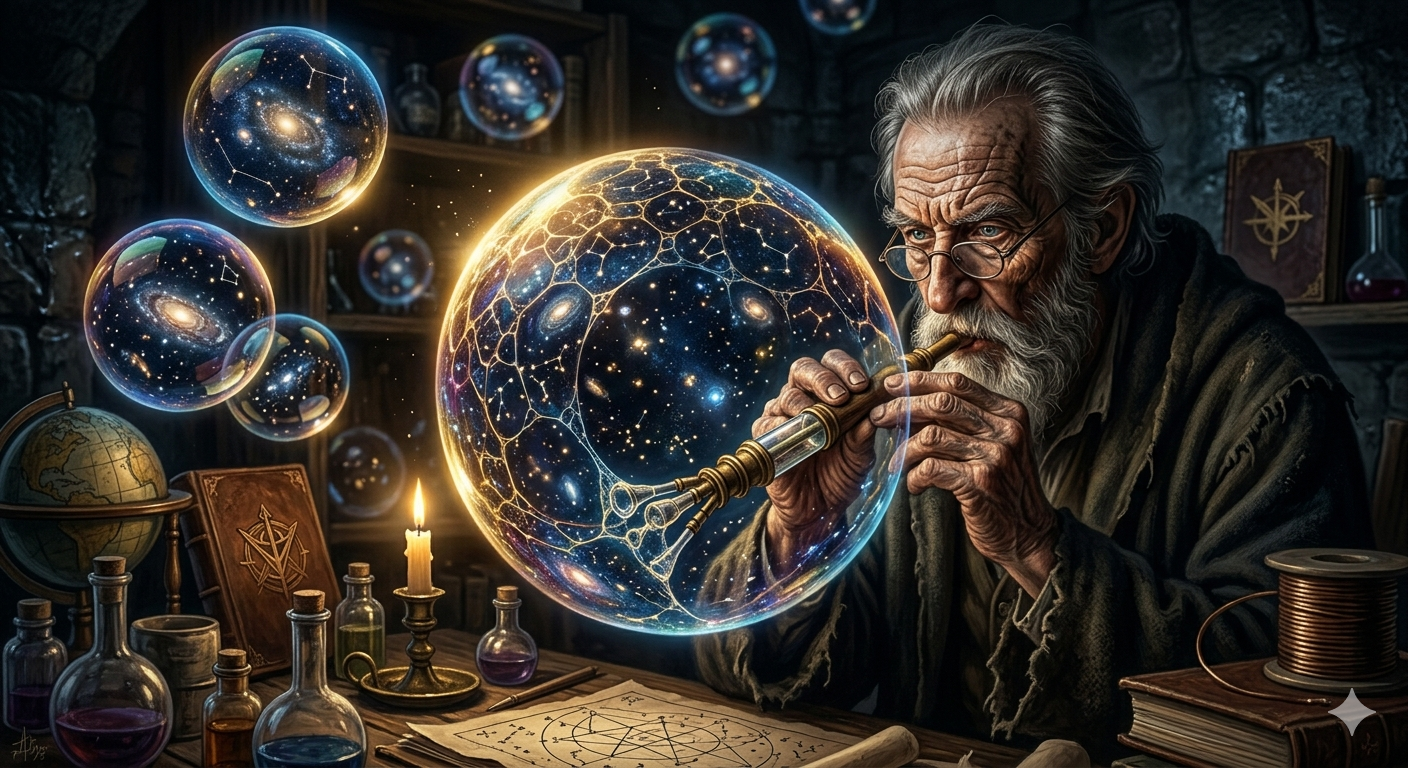
Yashka, however, did not listen to the mockery. He saw something in his bubbles that all the court scholars combined failed to perceive. For he noticed that when he released a great cloud of foam, the liquid and soap did not distribute themselves as a uniform, smooth mass. On the contrary—the fluid violently fled from the interior of the bubbles, flowing along the thin, delicate walls and gathering exclusively in narrow, sharp filaments at their junctions. The interiors of the bubbles remained completely empty, transparent, and devoid of matter, while the entire mass concentrated in a jagged, cellular network.
One night, when Mistress Vera shared with him the deepest maps from the Great Eyes of the Sky—ledgers wherein the real positions of hundreds of thousands of galaxies were charted—Yashka laid the drawings on the table beside his bowl of foam. He compared the sketches and felt a freezing shiver run down his spine.
The map of the Universe was not milk. It was a gigantic, mighty, three-dimensional soap foam.
Galaxies and stars were not distributed evenly in space at all. The citizens of the kingdom lived inside a gargantuan, jagged thicket where matter concentrated exclusively in infinitely thin, sharp filaments and mighty walls of density. These walls surrounded unimaginably vast, black, and completely empty spaces—cosmic voids where there was not a single star, nor a single atom of Visible Silver. The cosmos proved to be fractured, cellular, and ruthlessly granular in its grandest scale.
Chapter III: The Rune of the Tattered Silver
The news that the cosmos resembled the structure of foamy soap shook the foundations of the academy. The professors from the metropolis arrived at Yashka’s seaside cavern, carrying thick volumes and demanding proof of this sacrilege. They could not believe that Albi’s Great Cloak could create such a sharp, fractured architecture on its own, without the use of some brutal, destructive force.
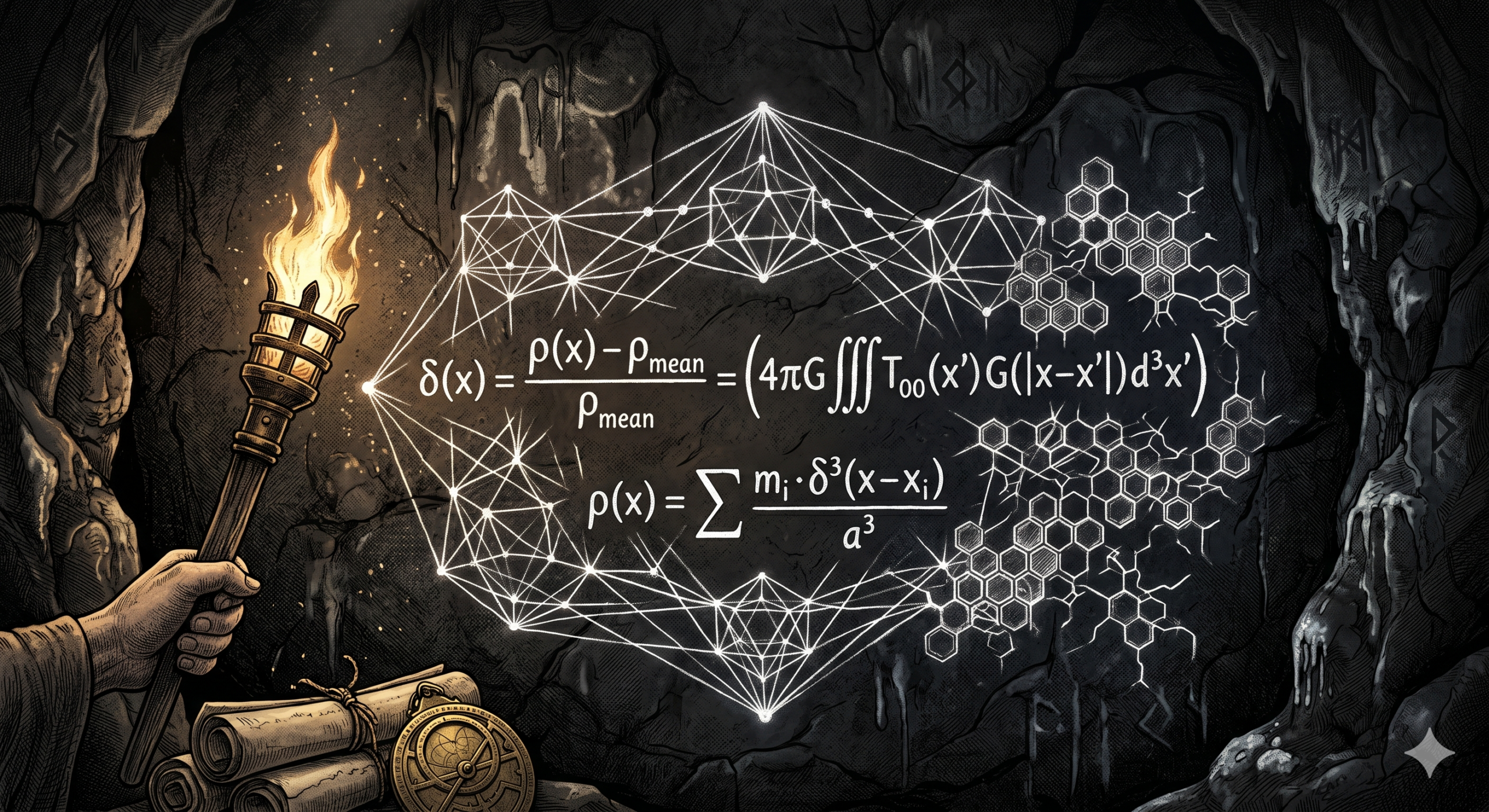
Yashka did not flinch before their wrath. He walked up to the rough black stone wall of the cavern and, using a piece of chalk, began to draw a stark, unyielding formula, which he called the Rune of the Tattered Silver. It was the mathematical ledger of the grand scale’s rebellion against the illusion of homogeneity:
The professors fell silent, staring at the gleaming white characters, and Yashka began to explain the anatomy of this incantation, breaking it down into simple and vivid images.
“Look at the first rune on the left side, which I have named $\delta_{barion}$,” Yashka began, tracing his finger along the symbol. “This is the Indicator of Cosmic Rebellion. It measures just how much the real world has escaped the cage of your smooth averaging. It is a measure of contrast—the larger this value, the more jagged, cellular, and distant reality is from your milky dream.”
Next, he pointed to the fraction in whose numerator two mighty forces collided:
“At the top, we see a dramatic collision. The symbol $\rho(x)$ is the Local Density of Silver, the real, raw mass of baryonic matter that we physically find at a specific point in space $x$—for example, within a dense, stellar filament. From this real value, we subtract the token $\bar{\rho}$, which I call the Toll of the Average Background Density. This is that fictitious, ideal cloud you invented in your offices, assuming that everything is evenly poured across the Cloak.”
Yashka struck his palm against the denominator of the equation:
“And this entire weave, this difference between truth and your fiction, we divide once more by that Toll of the Average Density $\bar{\rho}$. Why? To check how many times the local world exceeds your averaged imagination. And now, look at the final judgment of this equation, at those two powerful signs of majority pointed to the right: $\gg 1$.”
Yashka’s voice echoed off the rocks:
“This rune shouts to us that the Indicator of Rebellion is not close to zero! It is mighty greater than unity! Within the cosmic filaments and walls, the concentration of real matter $\rho(x)$ exceeds the average background hundreds, thousands of times! Baryonic matter has abandoned your smoothness. It has fled from the voids, compressing itself into gigantic, pancake-like structures of density. Your smooth model possesses no natural mechanism for such immense and sharp granularity!”
Chapter IV: The Catastrophe of the Smooth World
The professors stared at the wall in horror. They realized that the Rune of the Tattered Silver had exposed a deep, structural crisis of the smooth continuum. According to Albi’s traditional teachings, the force of gravity acting upon an ideally fluid background should require an infinite amount of time to fashion such sharp, cellular structures from a uniform mist.
In a continuous world, where every change occurs gently and without halts, forming such massive voids and such dense filaments required injecting intricate, artificial, and non-linear fluctuations into the mathematical models of the early cosmos. The professors had to manually “tear” their equations at the very beginning of creation, entering complicated initial parameters into the computers just to forcefully wring the cellular shape of Yashka’s foam from an ideal background.
“This is a dead end,” whispered the eldest of the professors, bowing his head. “Our smooth gravity does not give birth to foam naturally. We treat cellularity as an anomaly that we must extinguish and fit using free variables. Our Cloak resists this structure.”
The smooth world proved helpless against the power of the grand scale. The more precisely the Great Eyes of the Sky measured the edges of cosmic voids, the clearer it became that the traditional differential apparatus, based on infinitely small increments of coordinates, stumbles upon Yashka’s sharp walls of density. Fluid physics was stuck at a standstill—it could describe the smooth center of nothing or the smooth center of a star, but it became completely blind at the boundary between them, where matter abruptly underwent a leaping compression.
Chapter V: The Manifesto of the First Row
Sage Yashka approached the professors and placed a hand on the eldest one’s shoulder. His gaze was no longer full of anger, but of a deep, childlike empathy that characterized all true seekers of the weave.
“Do not fear these tatters,” Yashka said quietly. “The crisis you see is not the end of the world. It is merely the end of your illusion of a smooth background. The foam we discovered in the sky is not a caprice or an error of gravity. It is the most magnificent signature that discrete reality has left upon our sky.”
He drew from his pocket the small clay tablet of the Manifesto of the Discrete Rebellion, which the rebels had brought from the underground.
“Your Cloak of Albi cannot derive this foam because it assumes space exists before relation,” Yashka continued. “But if you abandon the idea of a continuous background and accept that at the baseline of the world lies a pure Relational Graph, everything will become clear. Cosmic foam is nothing other than a macroscopic image of how our network evolves through processes of local entanglement. The filaments of density are places where the threads of relations have thickened beyond measure, creating highways for the flow of information, while the vast voids are areas where the network has stretched, leaving only a minimal number of combinatorial connections.”
Yashka walked to the exit of the cavern and pointed to the night sky, where the massive glowing whirlpool of the Cosmic Foam stretched from horizon to horizon.
“The First Trial of the Cosmos is complete,” he announced. “We have proven that the grand scale mocks the smoothness of the continuum. Baryonic matter chose a cellular structure because space itself is sewn from discrete cells of relation. Now your eyes are open. It is time to descend to the other side of this very same battle—deep into the micro-world, where the Planck Catastrophe of Infinity awaits us in the Valley of Sparks.”
The professors left the cavern in silence, clutching the small clay tablets in their hands. They looked up and, for the first time in their lives, they did not see Albi’s smooth, secure satin. They saw a living, pulsing, gigantic network of relations that breathed to the beat of discrete combinatorial steps, leading them inevitably toward the next mysteries of the new era.