I. The Land of the Seamless World
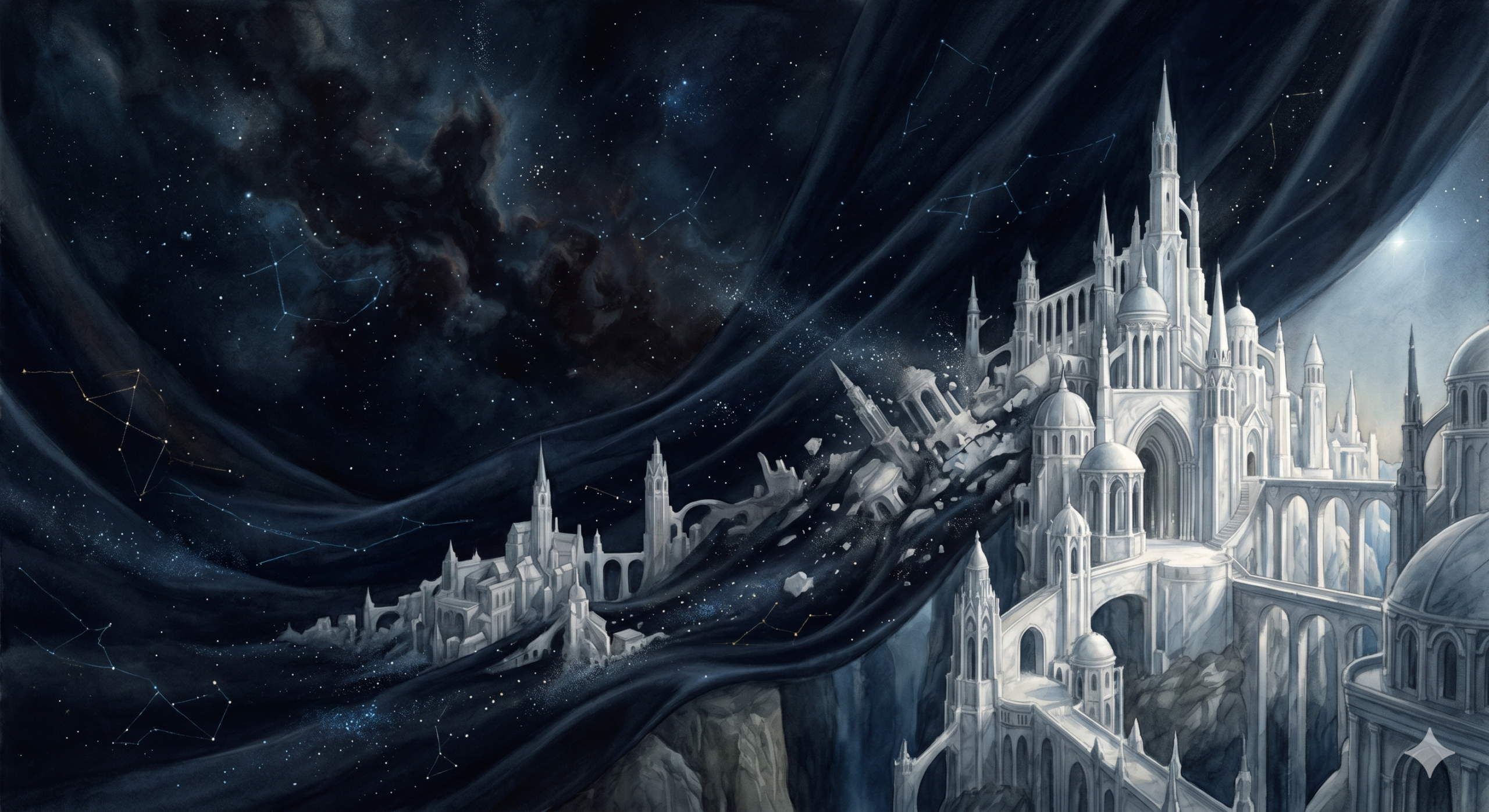
Once upon a time, in an age when adult men and women could still converse with the stars without the mediation of cold machines, there existed the Empire of Fluid Delight. The inhabitants of this realm called themselves the Adult Children, because despite the passing of years and the silver frosting their temples, they preserved in their hearts an unyielding faith in the stories of their forefathers. And the most important of these stories—the one upon which the foundations of their palaces, their laws, and even the rhythm of their breathing rested—spoke of the Great Velvet.
For in the Empire of Fluid Delight, it was believed that the entirety of creation, from the most distant, glittering nebulae to the delicate skin on an infant’s palm, was woven from a single, infinite, unbroken piece of cloth. To the Adult Children, the very concept of a “dot” or a “grain” was something nearly sinful, a manifestation of barbarism and ill breeding.
“The world is a river that flows without interruption,” the court sages would say, strolling through gardens filled with geometrically manicured roses. “Every moment passes into the next as gently as an evening shadow settles upon the grass. Between one instant and another, there is no gap, no fissure through which the unnamed void might peer. Space is like the most perfect, royal satin. You can run your mind across it for eons, and your foot will never stumble upon a single seam.”
In this world, time was not measured by the clicking of iron gears. Instead of clocks atop the castle towers, grand crystal bowls were installed, from which thick, golden oil seeped slowly, drop by drop. This movement was so smooth that looking at it gave the impression that time did not pass, but rather stretched like warm honey. The citizens of the empire built their homes from soft, white marble, polishing it until every pore and roughness vanished. They believed that striking a stone and shattering it into fine gravel was an insult to the cosmic order. Everything had to be a whole. Rivers did not consist of drops, but of a fluid essence of moisture. Light was not a collection of flashes, but a continuous stream of luminous milk poured across the firmament by invisible, benevolent hands.
This faith granted the Adult Children a peace that bordered on an eternal dream. Since everything was continuous, nothing could suddenly vanish. Nothing could snap. Death was merely a gentle blurring into the wider current of the tapestry, a transition from one shade of azure to another, darker, nocturnal velvet. The mathematicians of those days did not use numbers to count individual pieces—their art lay in drawing infinitely smooth lines that meandered across parchments like enchanted serpents, describing the undulating world without a single lifting of the pen.
II. The Maps of Old Bernie
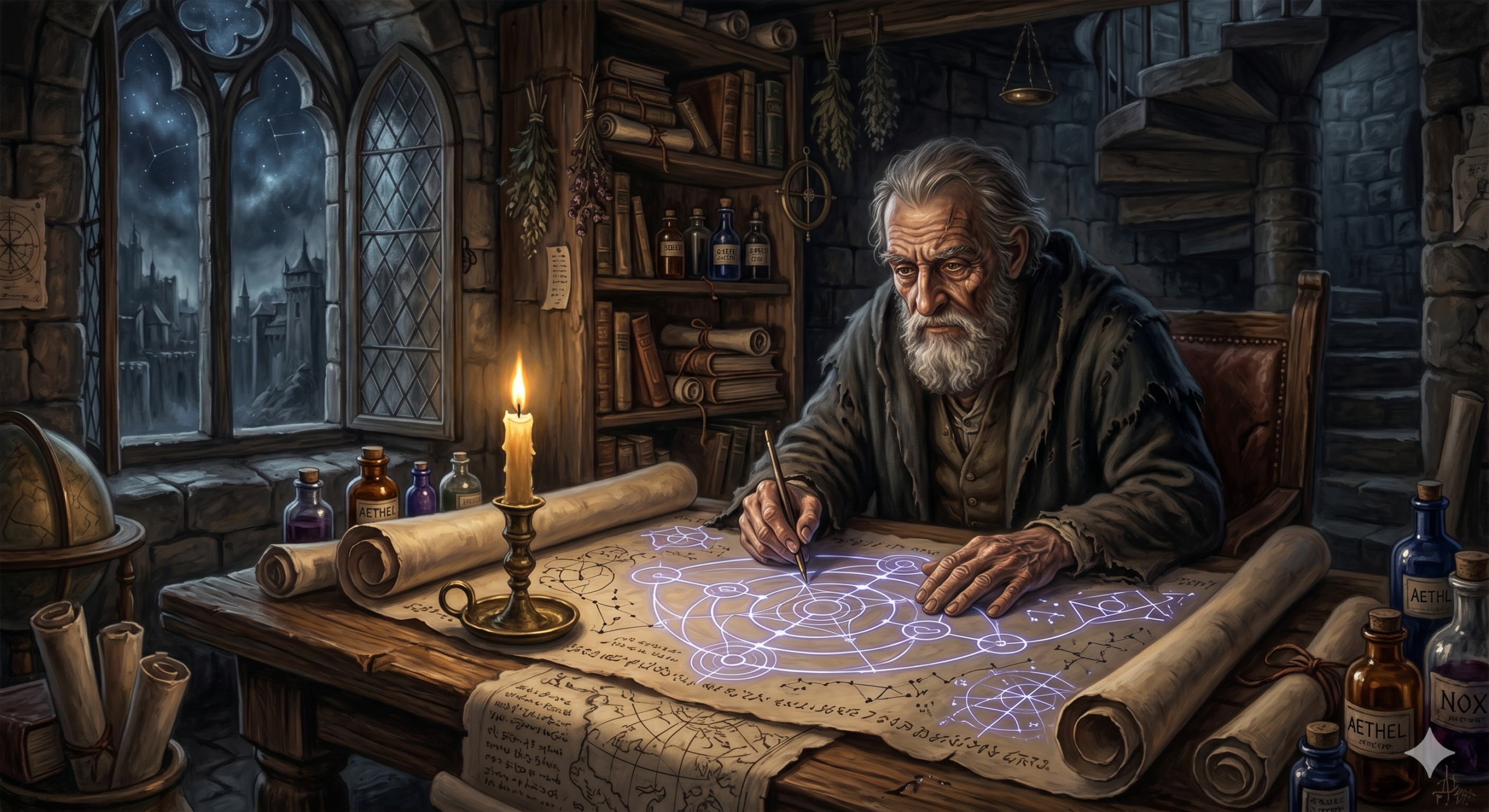
Before a tailor arrived in the empire to clothe the entire cosmos in a single decree, however, there lived an ancient cartographer whom everyone called Master Bernie of Göttingen. Bernie was a man with eyes as deep as wells and hands perpetually stained with rare ink. He spent his entire long life in a solitary tower, attempting to write down the rules by which the Great Velvet stretches and shrinks.
The inhabitants of the kingdom remembered him as the creator of the “Magic of Unbroken Paths.” Bernie was the first to prove that no matter how much the cosmic satin warped, no matter how deep the valleys formed within it under the weight of great thoughts or grand cities, the principle of fluidity would never be broken.
“Imagine,” Bernie would say, unfurling a blank, white scroll before the royal court, “that your world is the elastic skin of a magical creature. You can stretch it toward the stars, you can crumple it in your fist, you can create folds upon it so intricate that the human eye will lose itself in their labyrinths. But as long as you do not take a knife and cut this skin, as long as you do not allow the edges to pull apart from one another, revealing the nameless abyss… my magic will hold.”
Bernie drew maps that contained no cities, no mountains, and no kingdom borders. There were only lines—infinite rivers of geometry that crossed at strange angles, yet none of these angles were sharp. Everything was rounded, softened, brought into perfect harmony. They called this the Metric of Fluidity. The Adult Children came to Bernie’s tower to learn his incantations. He taught them how to describe the movement of clouds, not by counting rainy days, but by measuring the continuous pressure of the air, which, like an invisible, smooth ocean, flowed around the towers of the empire. Bernie believed that even the most chaotic change—like a volcanic eruption or the birth of a new island—was merely a sudden, yet still continuous, bulging of the material.
Yet, Bernie held one secret that he rarely mentioned, even to his closest disciples. Sometimes, when the night was exceptionally cold and the fog thickened over the valleys, the old cartographer would take up the thinnest needle the royal armorers had ever forged. He would attempt to touch the parchment so gently as to leave a single, infinitely small point. And every time he brought the tip near the surface, an inexplicable dread overcame him.
“If a point exists,” he would whisper to himself, while the candle burned low in his chamber, “if there is a place that has no width, no length, no neighborhood… then that is where my map ceases to be. A point is like a knife blade driven into the heart of my world. If the world is made of points, it means it is woven from a hatred of continuity.”
Bernie rejected these thoughts with loathing. He died believing that his lines were eternal, and his seamless geometry was the only truth the Adult Children needed to maintain their peace of mind. He left behind volumes filled with fluid spells that became the bible for generations of scholars to come.
III. The Arrival of Master Albi and the Royal Cloak
Centuries passed, and the Empire of Fluid Delight grew in strength, wrapped in the shroud of an unalterable faith in the Great Velvet. And then, just as the Adult Children began to grow slightly bored with the perfection of their smooth marbles, an extraordinary wanderer passed through the gates of the capital.
This was Master Albi. He wore an old, frayed cloak, his silver hair stuck out in all directions like tufts of wild grass, and in the corners of his mouth lingered a perpetual, enigmatic smile of a child who had just stolen a jar of preserves from his mother’s lantry. Albi carried no books or maps. In his hand, he held only a small wooden box, which contained—as he claimed—the most precious tailoring tool in the world.
When he stood before the King and the gathered Court, he did not bow low as custom demanded. Instead, he walked up to the grand, palatial window, looked at the dust motes swirling in the sunbeams, and spoke in a voice that sounded like the song of an old flute:
“Your Silk is beautiful, my dear friends. But you only live upon it. You do not understand how deep its elasticity truly runs. Allow me to sew a new Cloak of the Cosmos for you. A cloak that will show you that the sky itself can dance, shrink, and stretch to the rhythm of how you step upon it.”
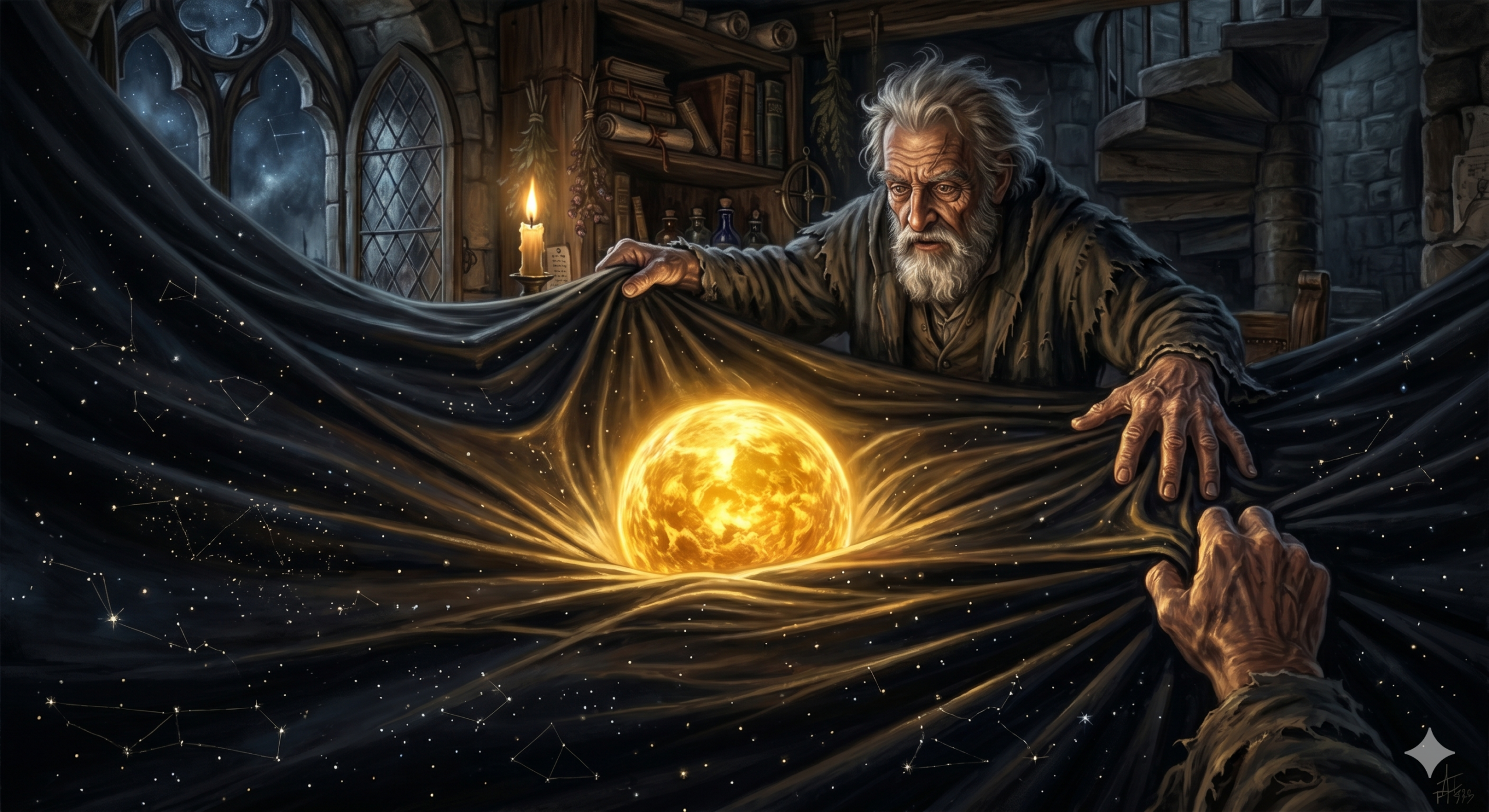
Albi requested the heaviest golden spheres from the royal treasury—the very ones that had hitherto symbolized the permanence and immutability of power. Then, between the columns of the throne room, he stretched a vast, black, perfectly smooth satin sheet that he had brought with him.
“Look,” Albi said, and gently placed a massive golden sphere, representing the Sun itself, in the center of the fabric.
In that instant, the Adult Children let out a quiet gasp of wonder and dread. The black satin, under the immense weight of the sphere, did not tear or resist. It bent gracefully, forming a deep, smooth, perfectly contoured valley. Time and space, previously considered a rigid scaffolding for the world, became a living, plastic medium before everyone’s eyes.
“And now, watch the motion,” Albi whispered, and tossed a small glass bead onto the edge of the fabric.
The bead did not roll straight down to strike the golden sphere. It began to revolve around it, gliding along the curved, smooth walls of the valley, tracing perfect, uninterrupted circles like an ice dancer. There were no strings, no invisible magnets. The bead’s movement was dictated entirely by how smoothly and effortlessly the underlying fabric had warped.
“This is my story,” Albi said, running his fingers through his wild hair. “Weight gives birth to shape, and shape guides motion. The sky is not empty. The sky is a grand, stretchable cloak upon which stellar giants press their footprints.”
The kingdom went wild for Master Albi. His decree became the absolute truth. The Adult Children spent hours sitting on terraces, imagining their planet resting in such a safe, velvet cradle, and every second of their lives as a smooth sliding into the depths of this cosmic cloth. Albi formulated the Great Law of Infinite Divisibility, which proclaimed: “No matter how close you approach the Cloak, no matter how much you bring your eyes to the material, you will always find the same, untattered smoothness. You can divide a step in half, and then that half into another half, without end. Between two points, there always exists an infinite space for more points. The world is safe, for the world has no seams.”
The citizens slept peacefully, cradled by this mathematical song. They were proud that their cosmos was so elegant, so predictable, and—above all—so infinitely continuous.
IV. The Great Tailor’s Song (Morphology of the Rune)
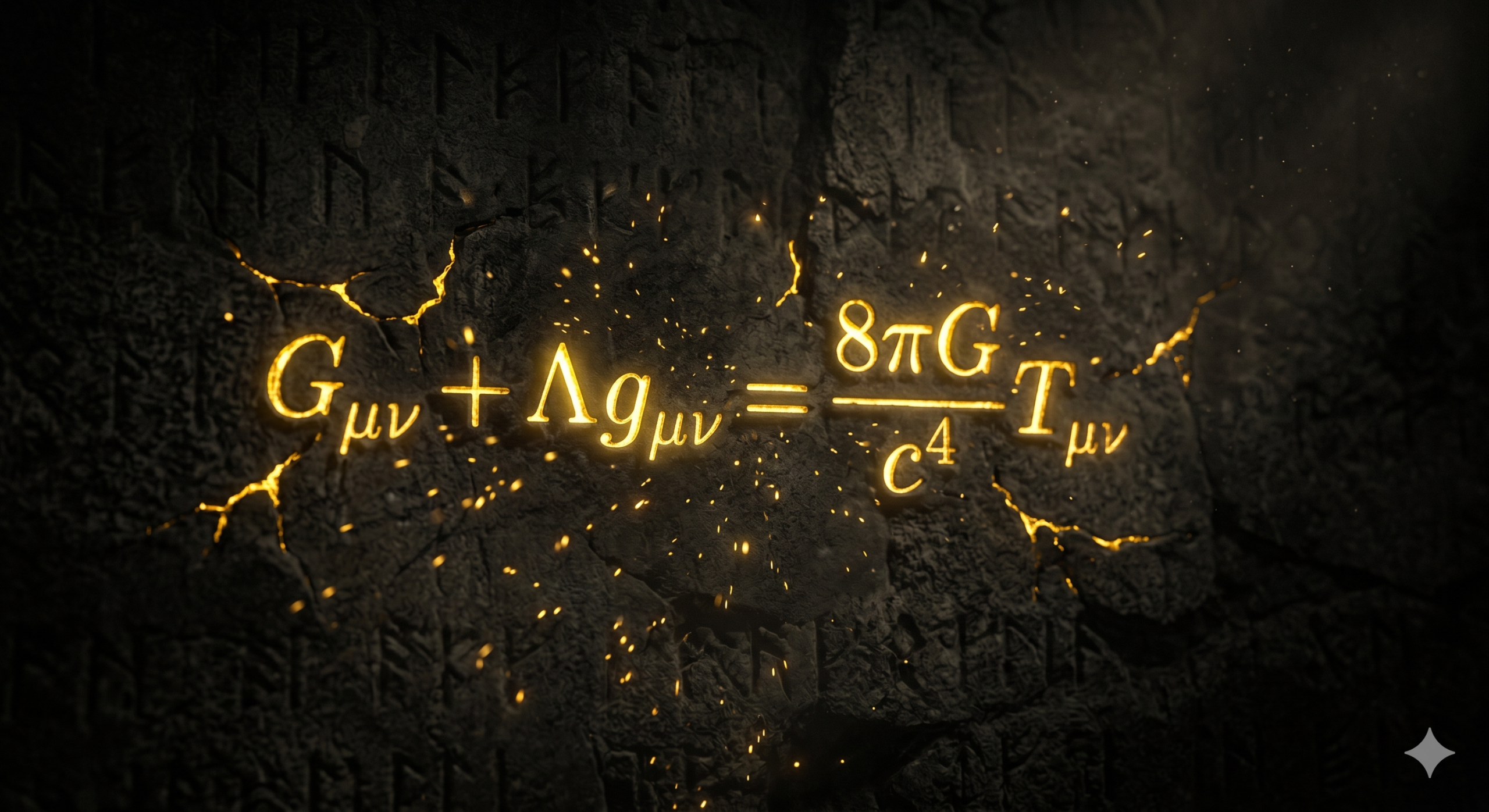
When the King, bewildered by this spectacle, asked what secret force bound the weight of gold to the bending of velvet, Master Albi reached into his small box. He drew forth a needle of pure light and, along the edge of the black canvas, began to embroider shimmering, golden runes. They arranged themselves into a single, potent, and unalterable Tailor’s Song, which the Adult Children in later years transcribed as the sacred equation of smoothness:
Albi sat upon the steps of the throne and began to explain the anatomy of this incantation to the gathered Adult Children, using the metaphors of their own seamless world.
“Look at the first rune, which I have named $G_{\mu\nu}$,” Albi began, pointing to the intricate, geometric glyph. “This is the Royal Gravity of Shape. It measures nothing less than the pure geometry of our Cloak’s warp. It is the rigorous record of how tattered, bent, and curved the valley is where our glass bead currently dances. It tells space how to arrange itself.”
The disciples of Bernie nodded, but their gaze was drawn to the next symbol, joined by the sign of addition.
“Next to it stands the Rune of the Cloth’s Hidden Breath, which is $\Lambda g_{\mu\nu}$,” Albi whispered, his voice turning mysterious. “The Silk itself possesses its own proud, inner nature. The rune $g_{\mu\nu}$ is the weaver’s metric pattern—the ruler by which we measure distances upon the smooth canvas. And that strange glyph $\Lambda$ is the Cosmic Anchor of Tension. It is the force that ensures the Cloak does not sag limply, but constantly breathes, tenses, and expands toward infinity, even if we were to strip it of all its golden stars.”
“And what lies on the other side of the equality sign, Master?” the King asked, enthralled by the glow of the embroidery.
“There lies hidden the heart of matter, the tensor $T_{\mu\nu}$, which I call the Great Weight of the World,” Albi cried. “It is the raw ledger of all the heaviness, energy, momentum, and brilliance that we place upon the canvas. These are our golden spheres, our loaves of bread, our bodies, and the fire of burning suns. The rune $T_{\mu\nu}$ shouts to space: ‘I am heavy, behold my motion!'”
Finally, Albi pointed to the fraction standing in the middle, bridging the world of shape with the world of weight:
“Yet, for these two foreign worlds—smooth geometry and heavy gold—to converse, they require a translator. It is this Great Tailor’s Multiplier: $\frac{8\pi G}{c^4}$. At the top rests the number $8\pi$, signifying the perfect, complete circle of the celestial sphere with which weavers enclose every mass, and the grand letter $G$—the mark of my forefather, the Giver of Attraction. At the bottom dwells the power of light bound to the fourth power: $c^4$. Light must run through the fabric fourfold, along every single dimension, to ensure that the information of the weight has propagated without the slightest delay, perfectly fluidly. This fraction is the cosmic exchange rate: it tells us how much gold is required to bend the satin by a single inch. Because light races incredibly fast, the denominator is colossal, which means our Cloak is exceptionally stiff—it requires entire worlds to press a visible valley into it.”
The Adult Children looked upon the golden equation with solemn awe. It became the supreme law of the Empire of Fluid Delight. It guaranteed that as long as this equation ruled the sky, the bond between shape and mass would remain unbroken, and the world would flow without seams, imprisoned in an eternal and safe loop of infinite continuity.
V. The Game of Infinities and the Shadow of the Scissors
For many decades after Albi’s departure, an era of great lightheartedness reigned in the Empire of Fluid Delight. Because the adult people believed that reality, as described by the sacred tailor’s equation, could be divided unto infinity without any consequences, they invented a strange game they called “The Game of Halves.”
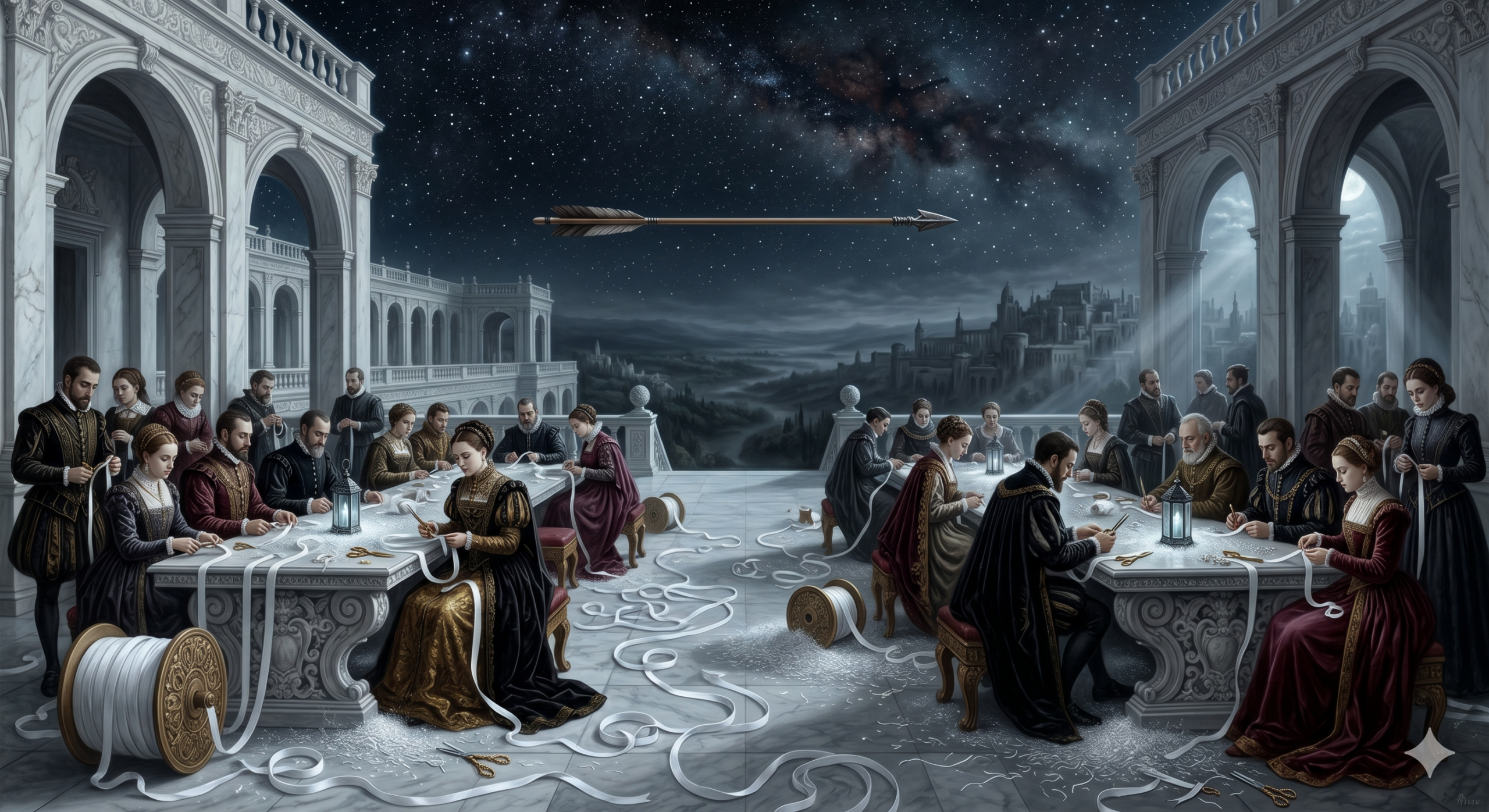
On the city squares, amidst marble fountains, elegant ladies and gentlemen in silk attire would gather. One of the participants would take a long, white ribbon and solemnly snip it in half. Then, they would pass one of the halves to their neighbor, who with pride cut it again. The game continued for hours, days, and sometimes even weeks.
“Look!” a young princess laughed, holding a shred of fabric between her fingers so thin it was nearly transparent. “I have cut a thousand times, and it is still here! It still has edges, it still has a center, I can still divide it! Master Albi was right: the world has no bottom! Beneath us stretches an eternal, infinite depth of smallness, into which we can descend without fear of ever striking hard ground!”
This game held a profound philosophical meaning for the Adult Children. It gave them the sense that they were masters of infinity. Since time and space were infinitely divisible, it meant that no moment was final. Something could always be squeezed in between. There always existed a “between.”
However, over time, as the game grew increasingly popular, certain scholars began to fall into a strange melancholy. For they noticed that this wondrous infinity carried a dark, cold shadow that slowly began to drape itself over their joy. The first to give voice to this aloud was a young disciple of the long-deceased Bernie, a lad named Janek, who instead of playing in the squares, preferred to spend his days tracking the flight of arrows shot by the royal archers.
“Consider,” Janek said during one of the grand banquets, interrupting the laughter of the revelers. “If what the smooth Rune of Shape $G_{\mu\nu}$ says is true, that the space between the target and the arrow is an infinitely divisible manifold, then our arrow should never reach its destination.”
The feast-goers froze with chalices in mid-air.
“What are you babbling about, Janek?” one of the ministers scoffed. “We see the arrow pierce the target!”
“We see it with our eyes,” Janek replied, his voice turning strangely earnest. “But listen to my mathematics. For the arrow to traverse the path to the target, it must first cover half of that distance, correct? And to cover that half, it must first traverse a quarter. And before that, an eighth, a sixteenth, a thirty-second… Since Master Albi’s material is infinitely divisible, an infinite number of tasks stands before our arrow! It must visit infinitely many points before it touches the goal. And how can something that is finite and mortal perform an infinite number of steps in a finite time?”
A deep, unsettling silence fell over the banquet hall. The adult people looked at one another. This thought was like a seed of poison dropped into their sweet wine. If the world was perfectly smooth and infinitely divisible, motion became a paradox. The world should turn into a statue, into a eternally frozen photograph where the arrow hangs in the air, trapped in a thicket of infinite points that it can never leap across.
The royal professors quickly tried to drown out these doubts. They wrote hundreds of thick volumes in which they attempted to prove that the sum of infinitely many small pieces ultimately yields a finite whole. They said infinity could be “tamed.” The adult citizens breathed a sigh of relief and returned to their games. They wanted to believe the problem was solved. They wished to remain in their illusion. But the shadow never truly left.
VI. The Prophecy of the Tattered Velvet
The real shock, however, came not from philosophers pondering the flight of an arrow, but from those who, by virtue of their trade, had to touch the smallest of things—the royal weavers and goldsmiths.
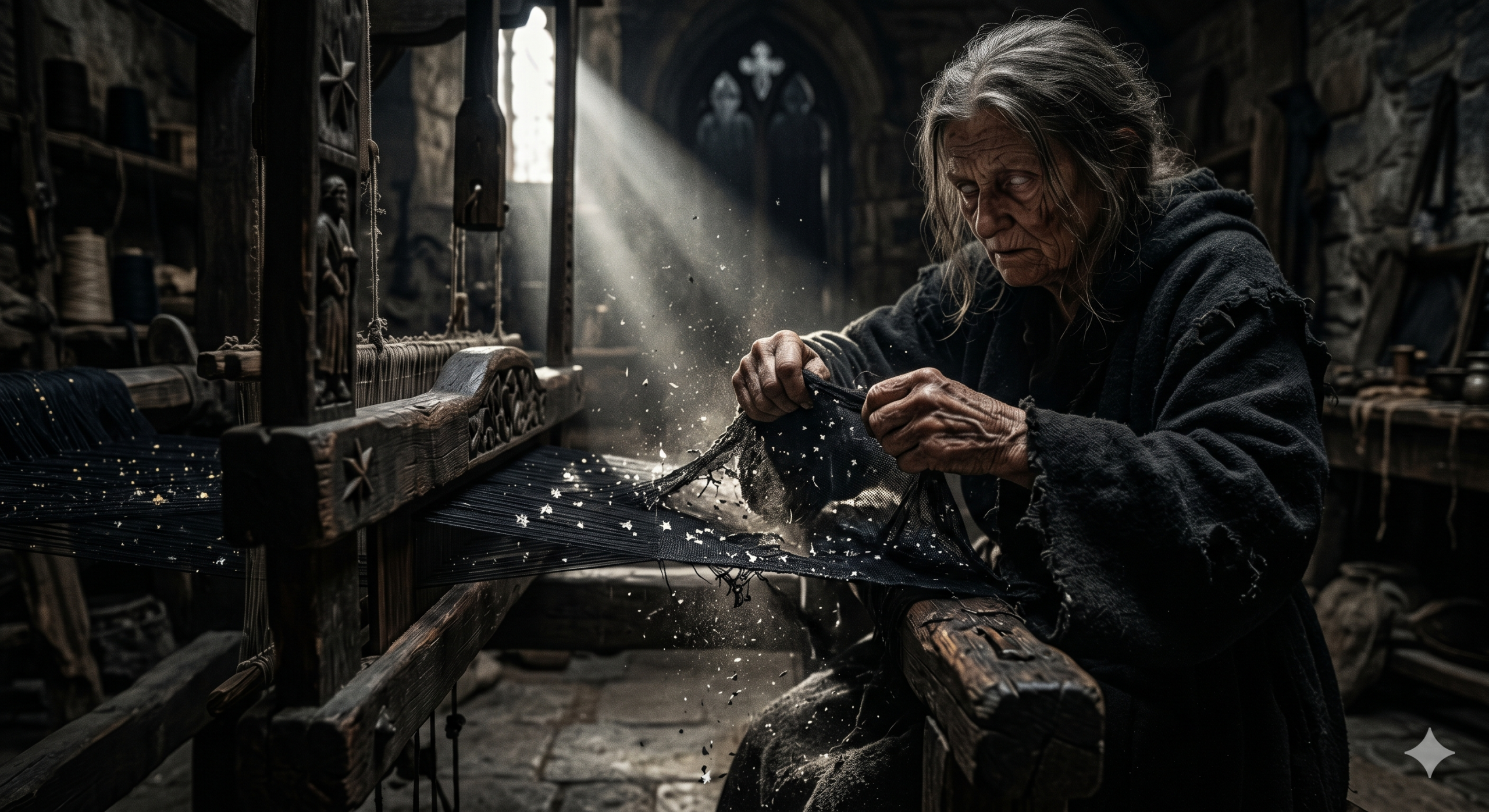
In the northern province of the empire, in a small manufactory hidden among the mountains, worked an old master weaver whom they called Blind Thomas. Thomas could no longer see the outside world, but his fingers were so sensitive that they could detect the structure of a material better than the finest optical instruments of the scholars from the metropolis.
One day, Thomas requested that the provincial governor be summoned to him, and when the governor arrived, the old weaver stretched out his hands, holding a scrap of fabric woven from the thinnest threads ever produced in the kingdom.
“My lord,” Thomas said, his sightless eyes seeming to look right through the governor. “The disciples of Master Albi tell you that the world is smooth and infinitely divisible. They tell you that you can cut the Cloak of the Cosmos without end, and beneath the scissors, you will always find the same soft satin described by the beautiful symbol $g_{\mu\nu}$. I tell you: they lie. They live in a world of delusions.”
The governor frowned, adjusting his rich, fluffy collar.
“How dare you speak thus of the great heritage of Master Albi, old man? His equations describe the motion of planets! I myself have seen how the golden sphere bends the black material!”
“Because you looked from afar, my lord,” Thomas replied, shaking his head. “When you look at a forest from a distance of a mile, you see a smooth, green carpet. Your eyes tell you the forest is a single, continuous rug. But when you walk among the trees, that rug vanishes. You find trunks, leaves, branches, and empty space between them. The forest turns out to be a collection of separate creatures.”
Thomas raised the scrap of cloth closer to the governor’s face.
“Touch this, my lord. My fingers feel what your professors refuse to see in their lenses. When I try to compress this material beyond measure, when I try to descend with my needle deep into the structure, the thread ceases to be fluid. I feel snags. I feel that at the very bottom, at the absolute foundation of reality, there is no smooth satin. There is a thicket. There are individual, hard, indivisible nodes. The world beneath our feet is not water. The world is sand!”
The governor drew back a step, as if Thomas had uttered the worst possible curse. The idea that the world could consist of “sand,” of separate, jagged grains of information, shattered the entire sense of security of the Empire of Fluid Delight. If space was granular, it meant that between the grains there must exist… nothingness. A gap. A lack of relation. A tatter.
“You are old and weary, Thomas,” the governor said coldly. “Your fingers play tricks on you. Our mathematics has proven continuity. There are no nodes. There is no sand.”
Thomas smiled mournfully and let the scrap of fabric drop from his hands.
“You may close your eyes, my lord. You may burn my words at the stake. But your satin is already tearing. The harder you squeeze your world in your great machines, the more you try to examine the heart of smallness, the louder you will hear the snap of ripping cloth. Your mathematics of continuity will give birth to monsters—infinities that will devour your equations. You will see division by zero, which is nothing less than the scream of terror from your smooth world when it attempts to touch a hard, indivisible grain.”
The governor left the manufactory in haste, ordering his officials never again to mention the prophecy of Blind Thomas. But the old weaver’s words, once spoken, began to drift through the provinces like a quiet, nocturnal wind.
VII. The Illusion of the Great Screen
The inhabitants of the capital tried to forget the troubling signs from the provinces. To distract from the gathering crisis of thought, the royal engineers built the grandest toy the world had ever seen for the Adult Children—the Grand Theater of Shadows.
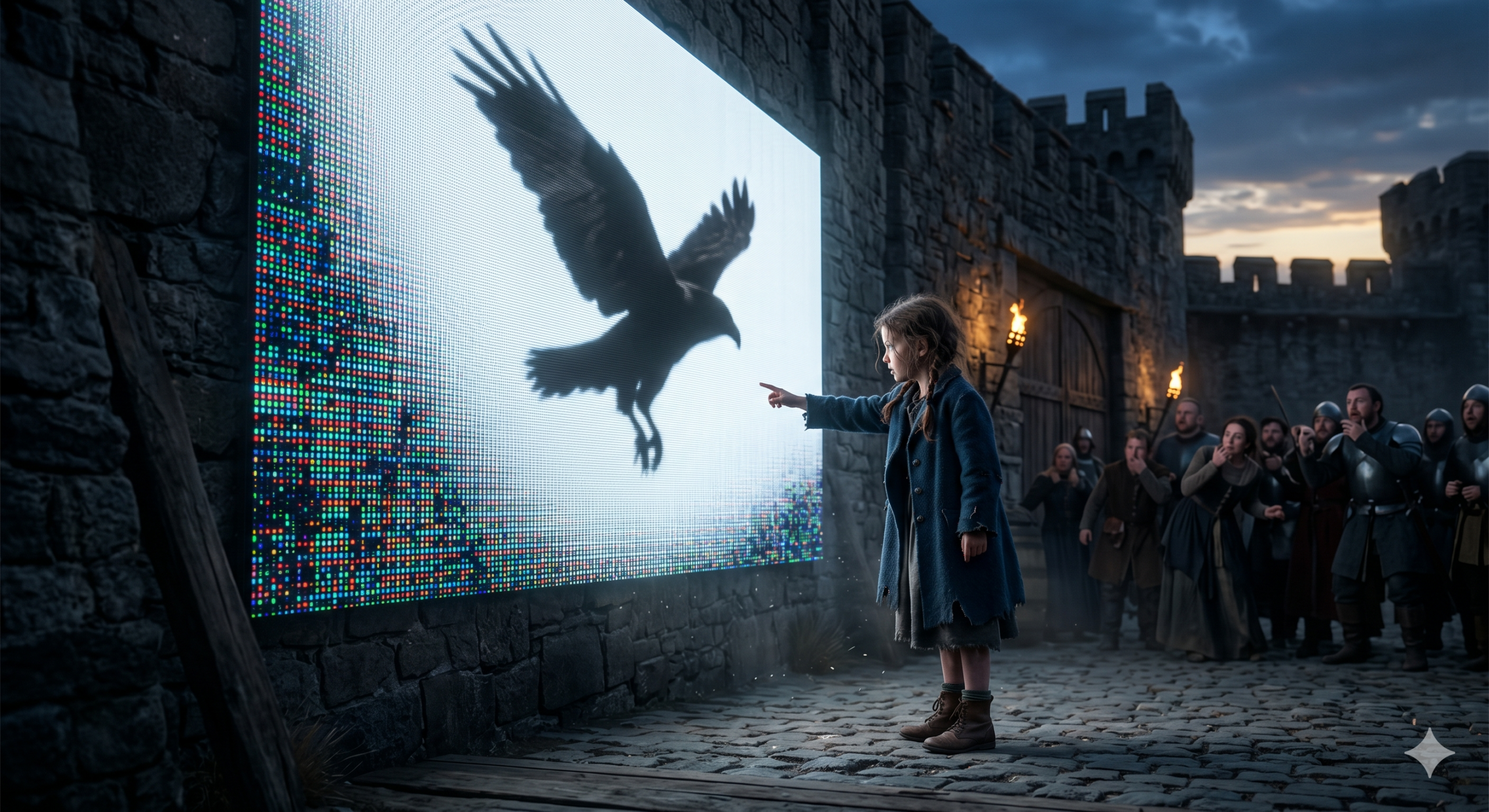
It was a gigantic white screen stretched across the palace wall, upon which moving images were projected using an intricate system of mirrors and oil lamps. They depicted beautiful tales of the birth of stars, the flight of birds, and smooth, undulating oceans. The Adult Children gathered in the square every evening, sitting on soft cushions and watching these fluid spectacles with delight.
“Do you see?” the Grand Director of the Court would call out, standing on a platform. “The motion on our screen is perfectly continuous! Look at how that heron flaps its wings! There is not a single halt, not a single jump! This is the ultimate proof that our Universe is the Great Velvet, and the Rune $g_{\mu\nu}$ works flawlessly at every single point!”
And so the people lived in wonder, watching the fluid shadows, until a little girl named Hania appeared in the square. Hania was a child who did not yet understand the gravity of adult decrees. She could not sit quietly on a cushion and contemplate the beauty of smoothness. She was curious about how the machine itself worked. While everyone stared at the center of the screen, admiring the fluid flight of the bird, Hania stood up and began to walk slowly, closer and closer to the white wall.
“Hania, come back!” the adults hissed behind her. “You are interfering! You are blocking the view! Sit down and admire the continuity!”
But Hania did not listen. She kept walking until her nose was just a few inches from the gleaming canvas. She reached out her hand and touched the surface with her finger. And then something extraordinary happened. Hania did not see a bird. She did not see the smooth wing of the heron.
“Mama! Papa!” the girl called out, not taking her eyes off the screen. “Come here! There is no bird here! There are only dots!”
The people gathered in the square froze. The Grand Director turned pale, his hand trembling on the lever of the mirror apparatus.
“What are you talking about, you troublesome child?” he shouted from the palace steps. “The entire square sees the fluid motion!”
“It only looks that way from far away!” Hania shouted back, tracing her finger along the canvas. “But up close, this bird is made of thousands of tiny, square specks! They don’t move at all! They only blink! One speck goes out, and another lights up! All this beautiful fluidity of yours is a cheat! Your screen is as full of holes as a sieve! It is made of tiny, separate pieces, between which there is nothing!”
Someone from the crowd stood up and approached Hania. Then another. Within moments, turmoil erupted in the square. The adult people, hitherto imprisoned in their beautiful illusion, began to flock toward the screen en masse. And every one of them, the moment they brought their eyes close to the canvas, experienced the exact same shock. Master Albi’s fluid tale, which was meant to be unalterable and infinitely divisible, shattered into raw, discrete fragments under the magnifying glass of proximity.
The illusion of continuity snapped on a crisp, autumn afternoon. The citizens of the Empire of Fluid Delight realized that for centuries they had admired only an averaged image from afar. Their smooth world, their seamless cosmos, their Metric of Fluidity—all of it was merely an illusion of weary eyes that could not perceive the granular truth hidden at the very bottom of creation.
They stood in the square in silence, staring at the blinking, square specks upon the screen, and in their hearts was born a mighty, terrifying, and yet fascinating question: if the Cloak of the Cosmos is not silk, but a mesh of separate nodes… then what does the weave that holds this world together truly look like?
Thus ends Book One of the chronicle, leaving the Adult Children on the threshold of the Great Crisis—at the moment when the old, smooth universe began to turn irrevocably into granular dust.