I. The Twilight of the Smooth Gods and the Great Silence
The autumn that followed the breaking of the Great Screen was the coldest and most somber in the entire history of the Empire of Fluid Delight. The marble streets of the capital, once glistening with flawless whiteness, now seemed strangely brittle, as if they had lost their inner cohesion. The Adult Children stopped venturing out onto their terraces. The traditional “Game of Halves” was banned by royal decree, and the white ribbons, once so joyfully snipped in public squares, now rotted in the gutters, abandoned and forgotten.
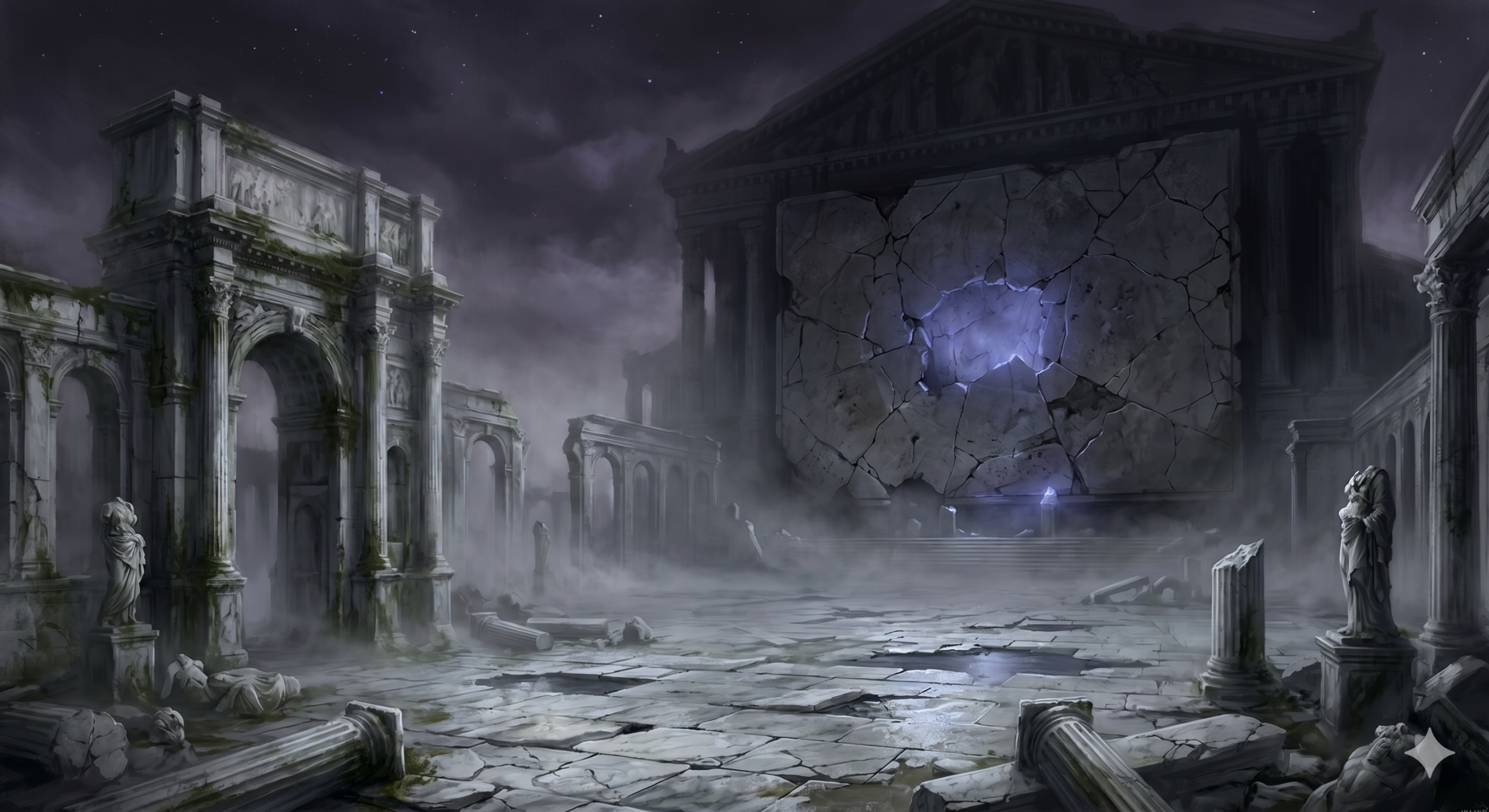
The Grand Theater of Shadows stood empty. For days, the Grand Director of the Court and his assistants tried to repair the white wall, applying layers upon layers of the thickest, milky lime. They desperately wanted to blur, conceal, and erase those cursed square specks discovered by little Hania. Yet, no matter how thick a coat of paint they laid down, the moment the oil lamps cast their light upon the canvas, the jagged structure of the pixels bled through the coating like the bones of a demon through skin that is far too thin. The illusion of continuity was dead, and with it, the ancient, blissful peace of the kingdom perished.
The court alchemists locked themselves away in the Grand Hall of Seaming. Their panic was so immense that the scrolls containing the Incantation of the Three Weights—which were meant to save the world using the invisible spirits of Dark Anchoring and Ethereal Breath—began to tear from the constant, frantic altering of numbers. The fictitious ninety-five percent of reality injected into the mechanical water calculators no longer brought any comfort. Everyone, even the simplest citizen of the empire, now felt that their entire existence had been based on an averaged lie, on a lazy gaze from afar that, for lack of better tools, had mistaken rough sand for smooth water.
The King did not leave his chambers. He sat upon his throne, staring at the crystal bowls of time, from which the golden oil now dripped with a terrifying, uneven thudding. Each plummet of a drop sounded like the strike of a tailor’s hammer. The monarch understood that if the truth of the world’s graininess leaked out to all the people, the Empire of Fluid Delight would shatter into billions of separate, unlinked particles. They lacked a new story—a story that would not fear seams, edges, and gaps, yet could still hold the cosmos within the reins of perfect order.
II. The Vault of Rejected Thoughts
While above on the surface the court sank into a helpless apathy, at the very bottom of the castle dungeons—in a place the chroniclers called the Vault of Rejected Thoughts—feverish activity took place. It was a gargantuan, dusty repository where for centuries everything that did not fit the official doctrine of infinite continuity had been dragged: faulty mechanisms, disrupted maps of old Bernie, twisted looms whose threads refused to tear smoothly, and the forbidden notes of rebels.
It was here, by the light of a single tallow candle, that a trio of heretics gathered: Janek, who still held in his hand a quill with reflections on the frozen flight of an arrow; Little Max, whose hands still bore the scars of burns from the Catastrophe of Smallness and the snapping of the scissors; and little Hania, clutching a cheap kaleidoscope which she treated as her most important weapon.
“If the professors upstairs think they can just sew up those holes in the screen, they are blinder than Thomas in his manufactory,” Max said, laying the remnants of his iron scissors upon the ancient oak table. “Albi’s fabric does not exist. Any attempt to descend to absolute zero always ends in an explosion of energy. We must stop pretending there is a background. We must destroy the very idea of the canvas.”
“But if there is no canvas, upon what shall we weave the world?” Janek asked, looking at Bernie’s infinite lines drawn upon the parchment. “Without a substrate, everything will plunge into the void. If we remove the Great Velvet, Vera’s galaxies will fly apart in a fraction of a second. We need something that holds the structure, but is not a continuous coordinate.”
Hania stepped up to the table and, with a loud clatter, set her kaleidoscope down.
“Look,” she said, inviting them closer. “There is no canvas inside here. There are only little, colored pieces of glass. They lie next to each other. But when you turn the tube, the glasses touch at their edges and create a beautiful castle. The castle doesn’t come from a background, it comes from which glass touches which!”
Janek and Max looked at each other, and in their eyes ignited the same wild spark of understanding that had once visited Albi and Bernie. The girl was right. Space was not a pre-existing arena where the gods had placed the stars. Space was a relation. It was a network. The distance between two events was not an independent line—it was the raw number of nodes that information had to physically visit, forging its path through the cosmic thicket.
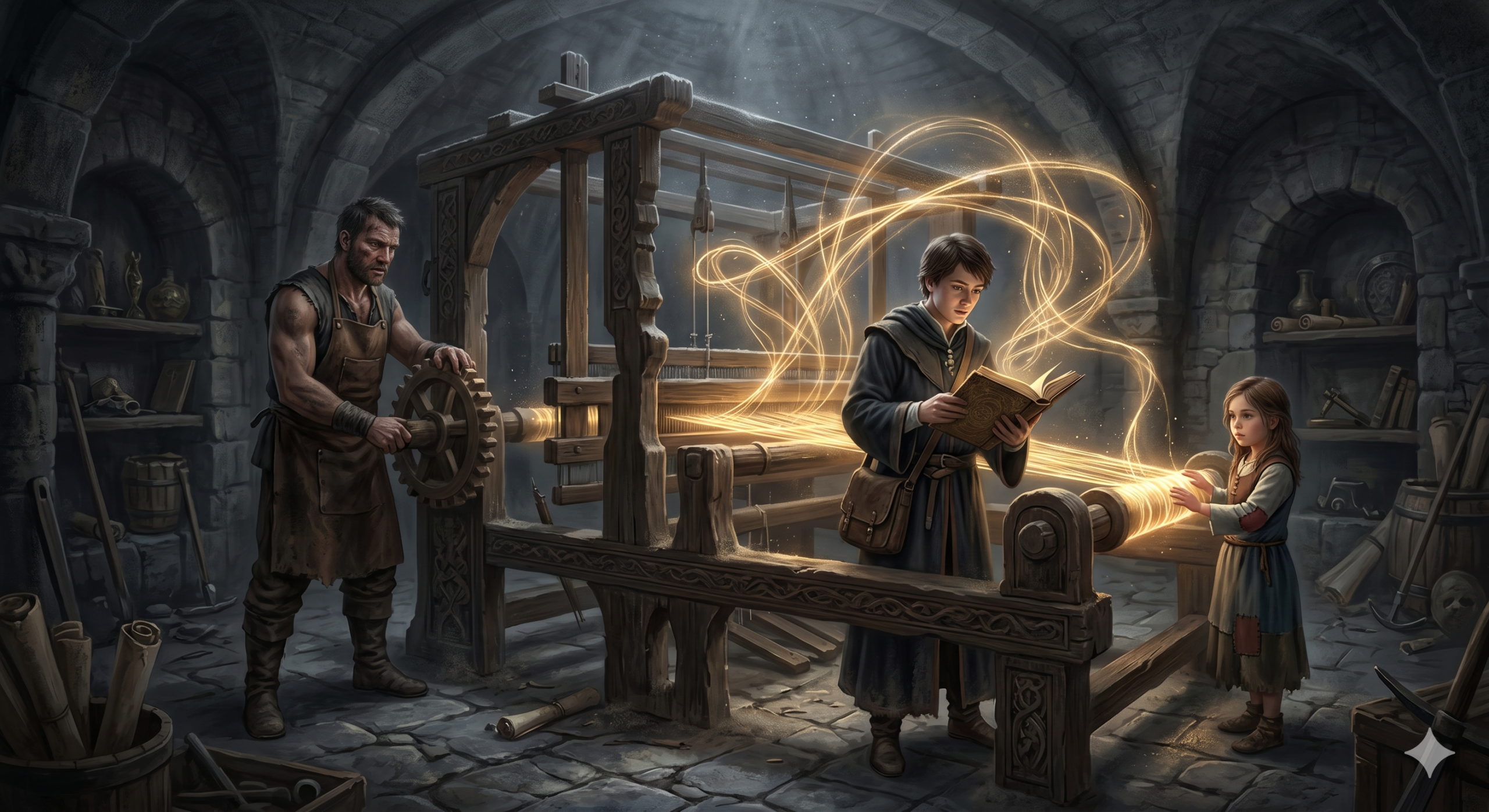
The rebels approached a grand, forgotten loom standing in the corner of the vault. It was no ordinary loom for weaving cloth. It was the Ancient Combinatorial Warp, a machine capable of binding together pure threads of light and darkness, weaving them into a structure that had no substrate—it was a substrate unto itself. They sat around it and began to design the Manifesto of the Discrete Rebellion.
III. The Song of the New Warp and the Rune of the Global Weave
For seven days and seven nights, the loom in the dungeons worked without a minute’s rest. Janek wrote the words of the manifesto, Max ensured the mechanical durability of the nodes, and Hania made sure the structure did not become too complicated for the human eye. They wanted to create one final, supreme incantation that would replace Albi’s old Tailor’s Song. An incantation that would require neither continuous tensors nor infinitely small derivatives.
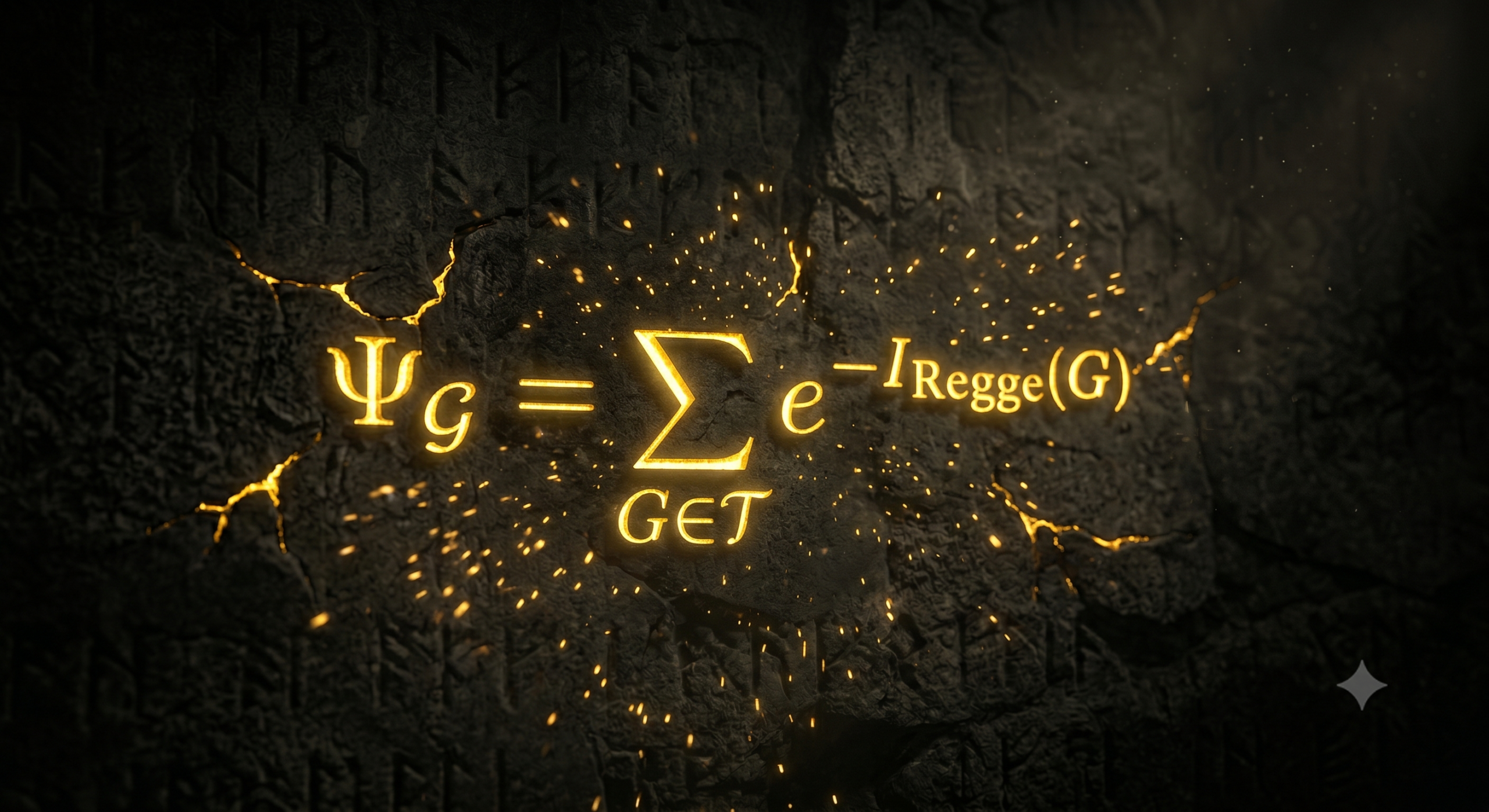
On the eighth day, as a pale winter dawn broke over the capital, Max used a glowing chisel to engrave a new rune upon the central wall of the vault, directly above the burning hearth, shimmering with pure gold—the Rune of the Global Weave:
As the golden dust settled upon the stone floor, Janek stood before the structure and, like a priest of a new era, began to loudly explain the hidden anatomy of this revolutionary pact with the cosmos.
“Hear me, denizens of the deep and you above who believe in ghosts!” Janek cried out, pointing to the first symbol, the mighty letter $\Psi_{\mathcal{G}}$. “This is the Spirit of the Global Weave. It is not a description of a single, permanently frozen spacetime. The rune $\Psi_{\mathcal{G}}$ is the sum of all possible shapes, all topological configurations, and all paths by which the world can weave itself in its evolution. It is the living state of the entire Universe, hidden within a combinatorial cloud of possibilities.”
He struck his palm against the next glyph, the jagged rune of summation $\sum_{G \in \mathcal{T}}$.
“Directly next to it stands the Grand Gathering of Paths,” Janek continued, his voice expanding and echoing off the vaults. “This symbol commands us to abandon the continuous Feynman integrals that gave birth to infinities in the Valley of Sparks. We now sum in a pure, discrete fashion, step by step. The token $G$ represents a single, concrete network of relations—a geometric map of connections without any background. And the symbol $\mathcal{T}$ is the Book of Permitted Tales. It is the collection of all graphs that respect the laws of cause and effect. The network cannot weave itself chaotically; it must preserve a causal direction for the flow of information, from birth to twilight.”
Max raised his blacksmith’s torch, illuminating the right side of the equation, where the magical growth base $e$ glowed, raised to a negative power.
“And here dwells the Reckoning of Just Tension, namely the exponent $-I_{\text{Regge}}(G)$,” Max called out. “We have removed Einstein-Hilbert’s continuous action from this place. We have replaced it with a raw, coordinate-free formulation of discrete gravity. This minus sign means that nature punishes and rejects those network configurations that are too jagged, unnaturally twisted, and generate wild deficit angles along their edge-hinges. Each network structure $G$ receives its statistical weight depending on how justly and harmoniously its combinatorial tension is distributed. The smaller the error of the weave, the greater the chance that a given configuration will become the real substrate for our macroscopic world.”
Janek lowered his chisel and looked upon the whole with pride.
“This rune is our manifesto. It tells us that gravity does not need the Great Velvet to bend space. Gravity is simply the statistical outcome of how billions of discrete networks sum up and permeate one another, creating for our imperfect eyes the illusion of a continuous, smooth background. We have removed the background, we have removed infinities, we have saved motion.”
IV. The Ten Trials of the Cosmos (Architecture of the Roadmap)
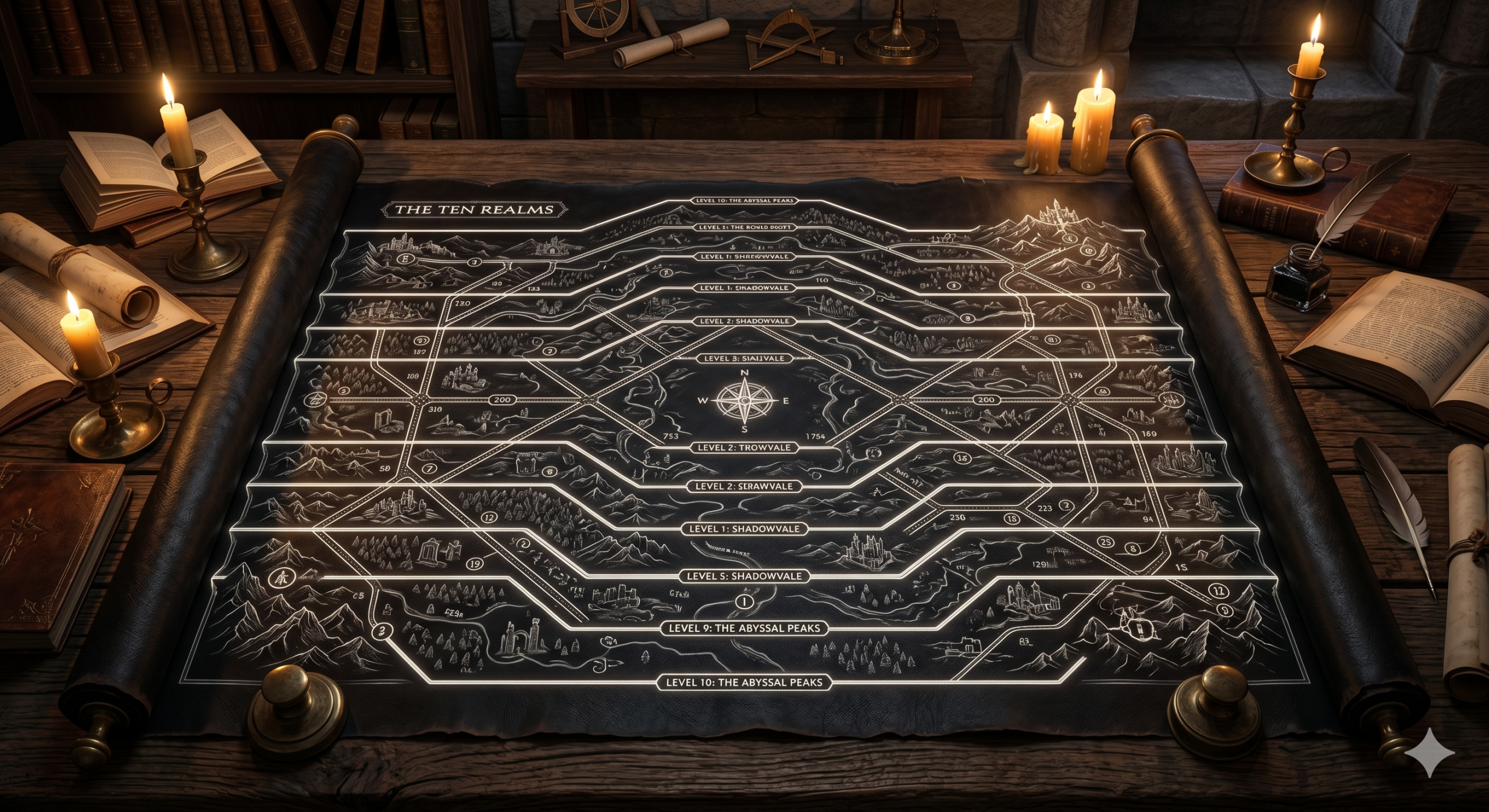
The rebels knew that merely writing down the Rune of the Global Weave would not suffice to convince the Adult Children to abandon their ancient comfort. They had to prove that their new, discrete framework could resolve all the crises before which the court alchemists had capitulated. Janek unrolled a great black parchment upon the table, mapping out a structure using white ink, which he called the Roadmap of the Ten Trials of the Cosmos.
“Our manifesto is not a static document,” Janek announced to the artisans gathered in the vault. “This is an evolutionary path through ten structural rows, ten grand collisions through which we must guide our science to lead it out of the dead end. Each row of this map is a battlefield between the old illusion of smoothness and the new truth of the network.”
He began to point to the successive steps on the map:
“At the very beginning, in Row One, we shall collide the Cosmic Zeldovich Foam with the Planck Catastrophe to show that at the baseline of the world lies a pure Relational Graph, completely free of any coordinates. In Row Two, we shall reject Riemann’s tensor background and prove that distance is merely the number of geodesic edges. In Row Three, we shall resolve the paradox of frozen time by defining the ticking of seconds as a structural micro-transport delay of an impulse wandering across the network.”
Max stepped up and indicated the middle steps of the roadmap:
“Further, in Rows Four and Five, we shall confront the challenge of dimensionality and the calculus of gravity. We shall show that dimension is not a locked-in background number, but a fluid spectral feature of diffusion. Under the magnifying glass of the micro-world, our network will turn out to be a one-dimensional thread, which only from afar creates the illusion of a three-dimensional weave. We shall deploy the structure of Regge’s discrete action, which will allow us to calculate gravity without using Einstein’s non-linear derivatives.”
Finally, little Hania placed her finger at the very bottom of the parchment, where a massive, central point of convergence loomed:
“And in Rows Six, Seven, and Eight, we shall remove all invisible ghosts from the cosmos! We shall replace dark matter profiles and artificial Yukawa couplings with a single, rigid, and frozen topological motif named $F^*$. This motif has a magnitude of exactly nineteen points and allows for no manipulation of numbers. In the macro-scale, it will give us an ideal cosmic void wall gain of nineteen-halves, and in the micro-scale, it will calculate particle masses with an error smaller than thousandths of a percent. And at the very end, in Row Ten, our network engine will heal the heart of the Black Hole, introducing a hard scale-cutoff barrier because of which curvature will never explode into infinity!”
The small craftsmen listened to these words with bated breath. The Map of the Ten Trials was rigorous, geometric, and devoid of any emergency escape parameters. It was a hard, uncompromising declaration of war against the illusion of continuity—a war they intended to win using pure combinatorics.
V. The Dawn of the First Vertex (The Manifesto of Rebellion)
That very night, the rebels decided to emerge from the underground and proclaim their manifesto to the entire kingdom. They carried no swords or torches of destruction; their only weapons were hundreds of small clay tablets upon which Max had baked the new Rune of the Global Weave and the ten-row structure of the cosmic roadmap. They hung them upon all the walls of the capital, upon the palace gates, and even upon the sealed bowls of time.
When the sun rose over the Empire of Fluid Delight, the adult people left their homes and with disbelief began to read the words of the Manifesto of the Discrete Rebellion. The words were simple, hard, and struck at the very core of their long-standing dread:
“Citizens of the Kingdom of Continuity! For centuries you have been told that you are but passive observers of a smooth, infinite Cloak of the Cosmos, which warps under the weight of foreign stars. You have been told that your world consists of ninety-five percent invisible spirits, whom you must fear and whom you cannot touch.
We, the Weavers of the Discrete World, announce the end of this illusion. Space is not velvet—space is a network of direct relations. You are not specks upon a canvas; you are active nodes in a grand, cosmic graph of reality. Your time does not flow smoothly—it is measured by the structural delay of every choice you make, every connection you forge with the world. We reject infinite divisibility, which birthed monsters in denominators. We embrace the grain, we embrace finiteness, we embrace relation. The world does not need a background to exist. The world is us, connected by a thread of causal resonance.”
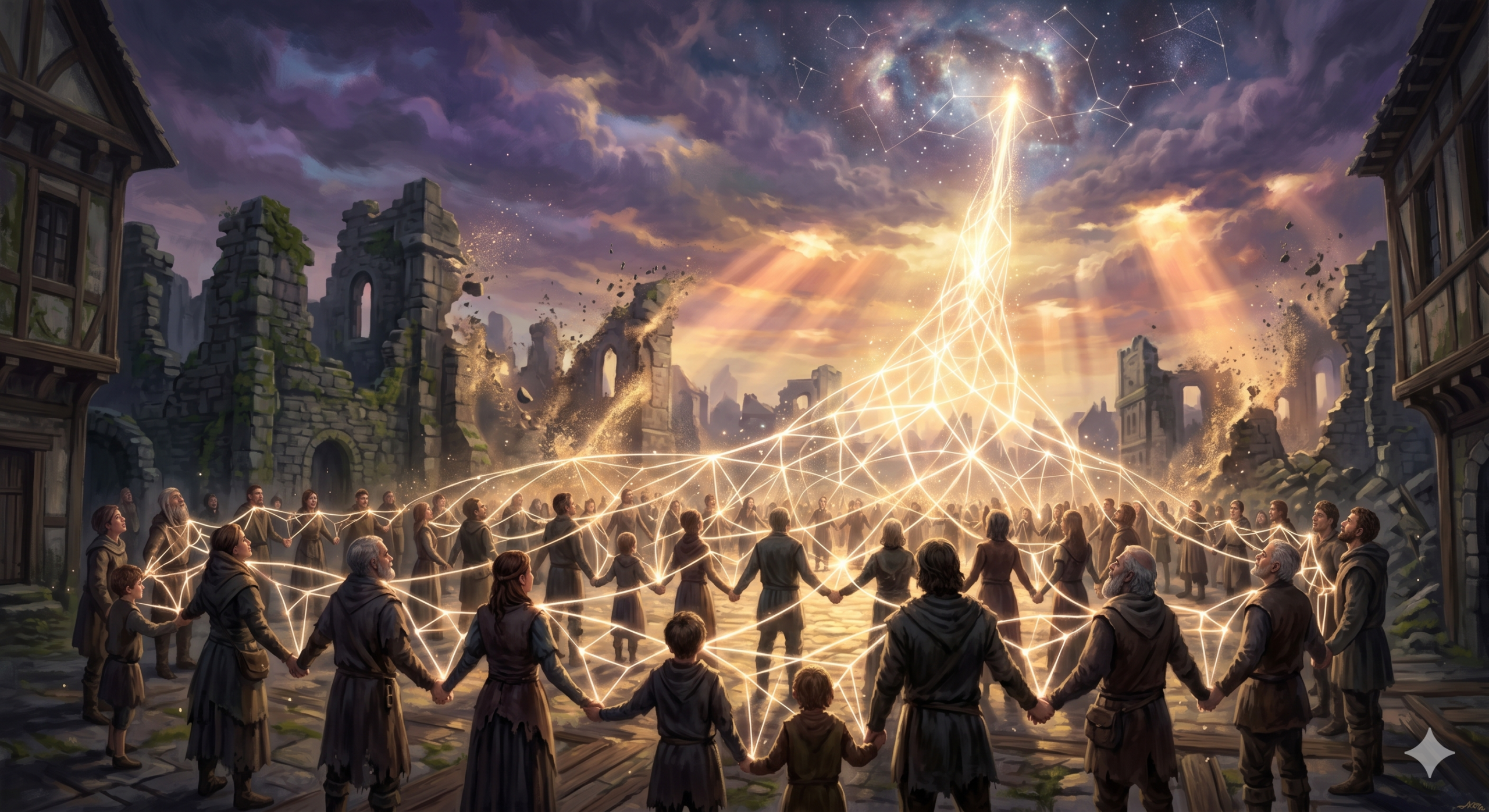
The court professors ran from the palace, screaming of heresy and trying to tear the tablets from the walls. But it was already too late. The seed of rebellion had been sown in the minds of the Adult Children. People began to approach one another, clasping hands, looking at their relationships not as a fluid, inert current, but as the hard, responsible nodes of a network that they themselves build in every single beat of their lives.
The marble empire, though it still stood upon its old foundations, lost its dogmatic power. Underneath, within the deep structure of thought, a new world was emerging—a world of discrete resonance that no longer needed the lie of infinite smoothness to preserve its beauty and perfect order. The journey through the Ten Trials of the Cosmos had just begun, and the first vertex of the new network flared in the sky with the pure, uncompromising light of truth.