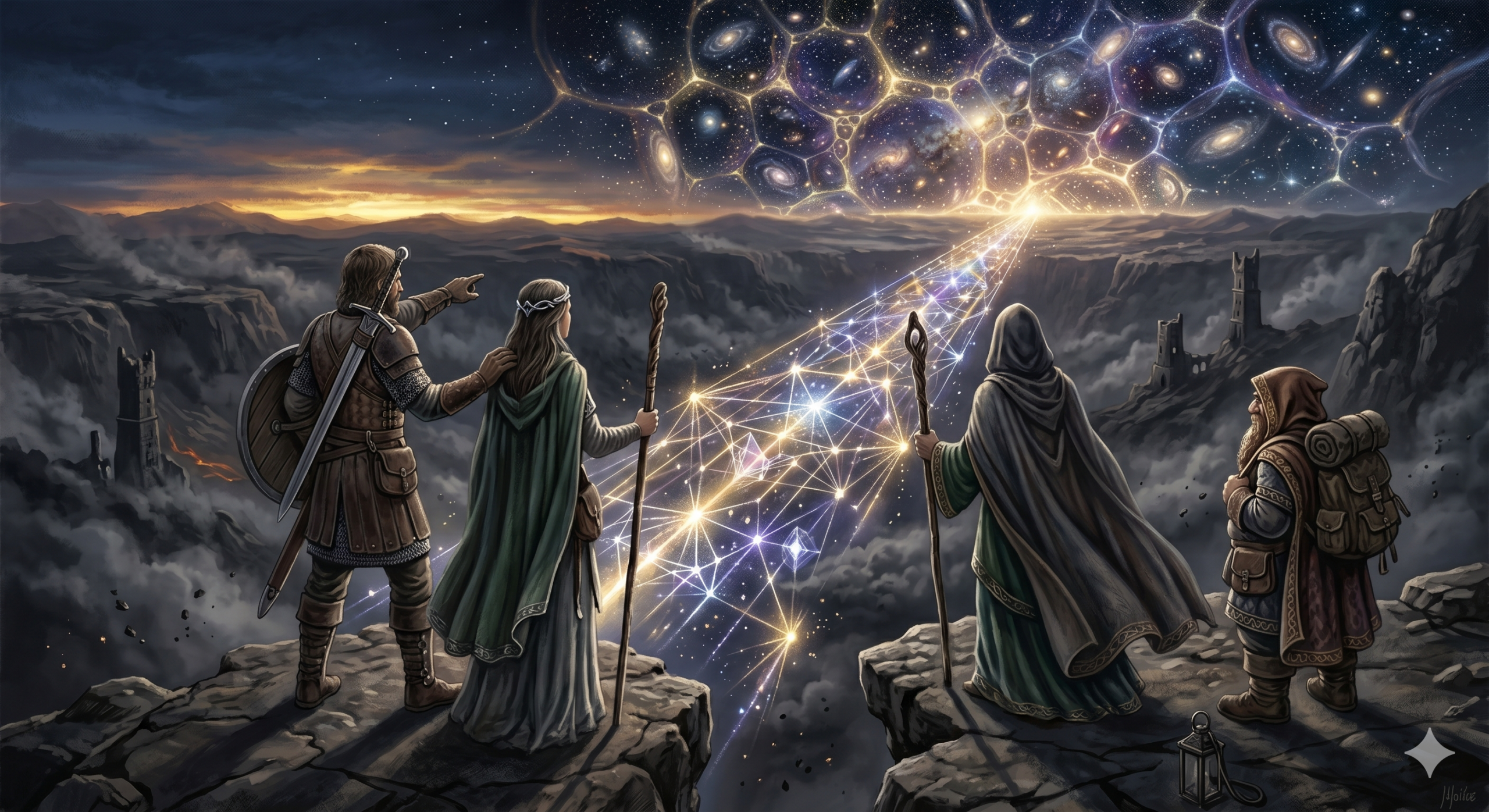
Chapter I: The Forge of Small Wonders and the Cult of the Infinite Blade
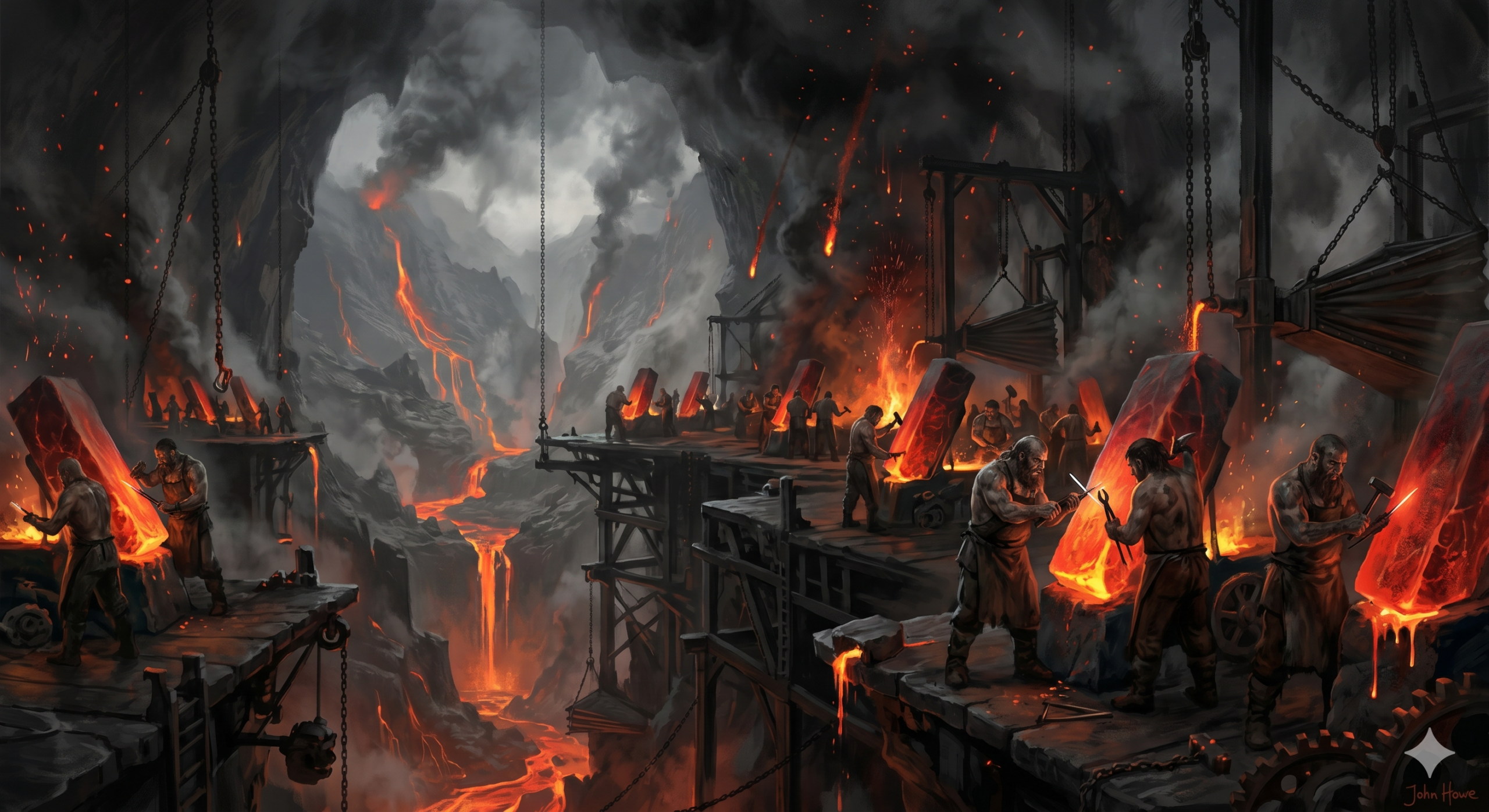
While Sage Yashka was blowing his soap bubbles on the seaside cliffs, attempting to understand the jagged anatomy of cosmic voids, a completely different kind of madness was nesting deep within the heart of the continent. A narrow, smoking tectonic fissure known as the Valley of Sparks was home to the small blacksmiths, clockmakers, and goldsmiths of the Empire of Fluid Delight. If the capital of the kingdom lived by the monumental grandeur of grand marble edifices, the Valley of Sparks throbbed with the feverish rhythm of microscopic craftsmanship.
The inhabitants of the valley were boundlessly in love with the Cloak of Albi, yet their love was obsessive and morbid. They pored over their anvils by the glow of melting raw materials, striving to prove that the infinite divisibility of the world was the most magnificent gift of the gods of continuum. Their ultimate pride was their ability to sharpen artisan tools. Every year, the Great Tournament of the Grind was organized in the valley, during which young apprentices tried to forge a needle so thin and a knife so sharp that their edges would touch the very bottom of smallness.
“Our Cloak is as smooth as ice!” shouted the blacksmiths, striking glowing rods with their small hammers. “We can descend with our blade deeper and deeper. If we divide the width of the blade in half, and then in half again, the material will never resist us. Underneath, we will always find another infinitely small layer of velvet, ready to receive our cut. Motion in our world is free, for space has no thresholds or teeth!”
They believed that the energy of fire and the brilliance of sparks were like liquid gold—they could be poured into smaller and smaller droplets, and every droplet, though smaller than an ant’s eye, would still preserve the same nature, the same continuous essence of fluidity. Their furnaces had no rigid grates; the air supply was regulated by intricate leather bellows that pumped the wind in such an uninterrupted manner that the flame resembled a motionless, shimmering river. The adult artisans lived in a blissful illusion that they controlled the smallest pulse of creation, and their rulers could measure smaller and smaller fractions of space without any limit.
Chapter II: The Arrival of Old Max and the Rough Fire
And then, at the height of the blacksmiths’ complacency, Old Max appeared in the Valley of Sparks. He was an artisan with a stern, heavily lined face who wore a heavy apron of thick, hardened oxhide, stained with acids and scorched by thousands of sparks. Max did not sharpen knives or polish mirrors. He had spent half a century in a solitary stone workshop at the bottom of a ravine, studying the pure glow of glowing iron.
When he entered the main forge of the empire, he did not admire the flawlessness of the local wares. He walked up to the largest furnace, spat into the fire, and spoke in a voice that sounded like the grinding of two granite boulders:
“Your smoothness is a blind illusion for lazy eyes. You celebrate infinite divisibility, yet your fire mocks your lies every single second.”
The Grand Master of the Forge looked up from his anvil, narrowing his eyes with irritation. “How dare you insult our art, old man? Our needles cut hair into ten thousand pieces! Master Albi himself proved that energy flows like water!”
“Cast away those fairy tales for good children,” Max snapped. “Look at this furnace. If energy were fluid water, your furnaces at the highest temperature should emit a blinding, destructive glare of invisible violet. They should suck all the warmth out of you and turn your valley into a freezing desert in a fraction of a second. And yet, it does not happen. Do you know why?”
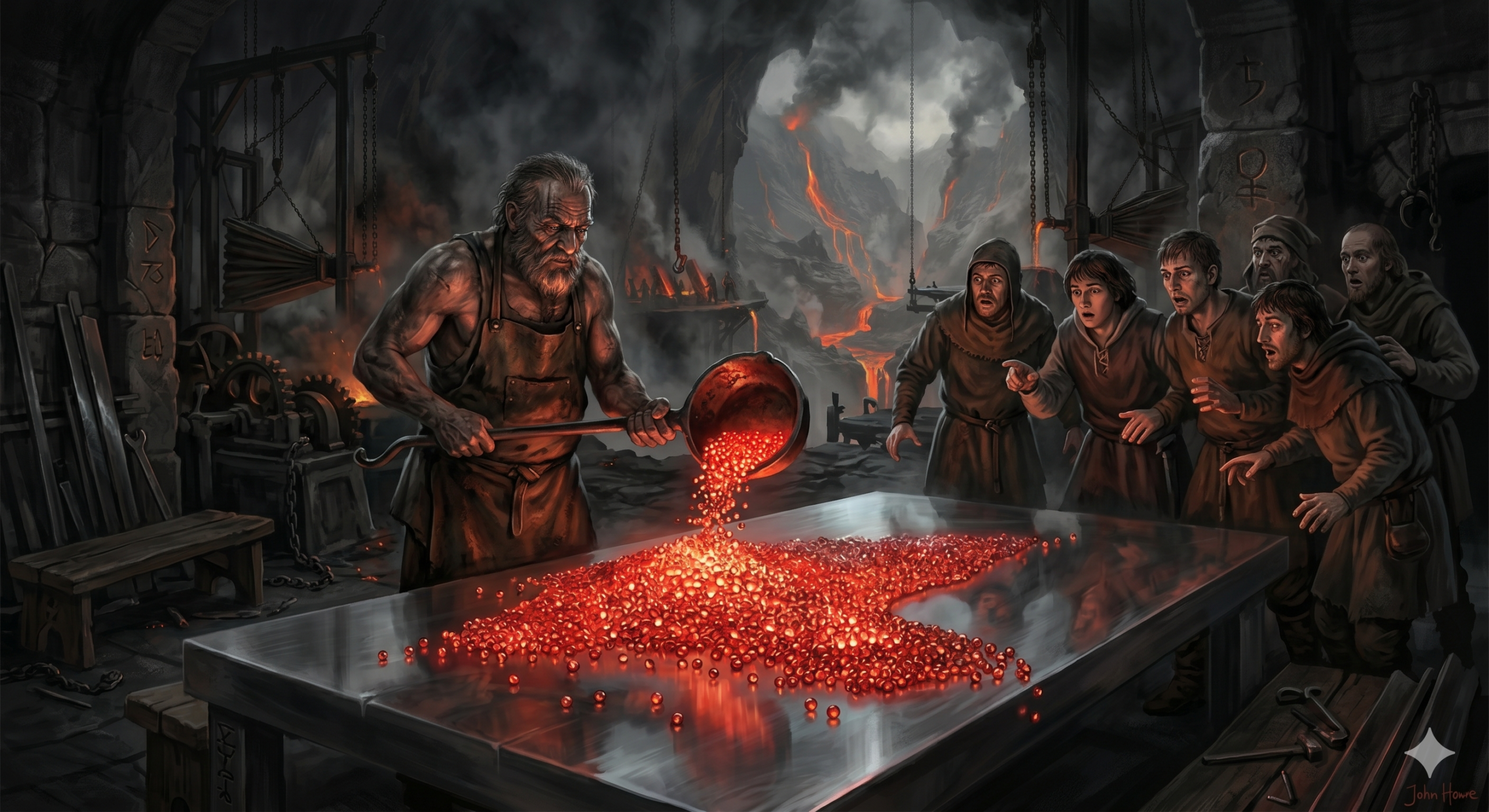
Max pulled a small iron box from his leather bag, inside of which rattled thousands of tiny glass beads of perfectly equal size.
“Fire does not flow,” Max announced, pouring the beads onto a metal table. “Fire leaps. Energy is not a river, but a collection of hard, indivisible packets that are born and die as wholes. When your furnace burns, it does not pour light continuously. It fires these small, energetic portions—quanta. Every spark has its minimum price, below which nature refuses any transaction. Your rough fire consists of teeth, and you try to describe it using the smooth pages of your parchment!”
The blacksmiths froze. The story of “toothed” energy was a strike at the very foundation of their world. If energy was granular, it meant it could not be divided infinitely. There was a lower threshold—a hard, indivisible boundary where Albi’s smooth mathematics had to halt its scissors.
Chapter III: The Rune of the Exploding Spark
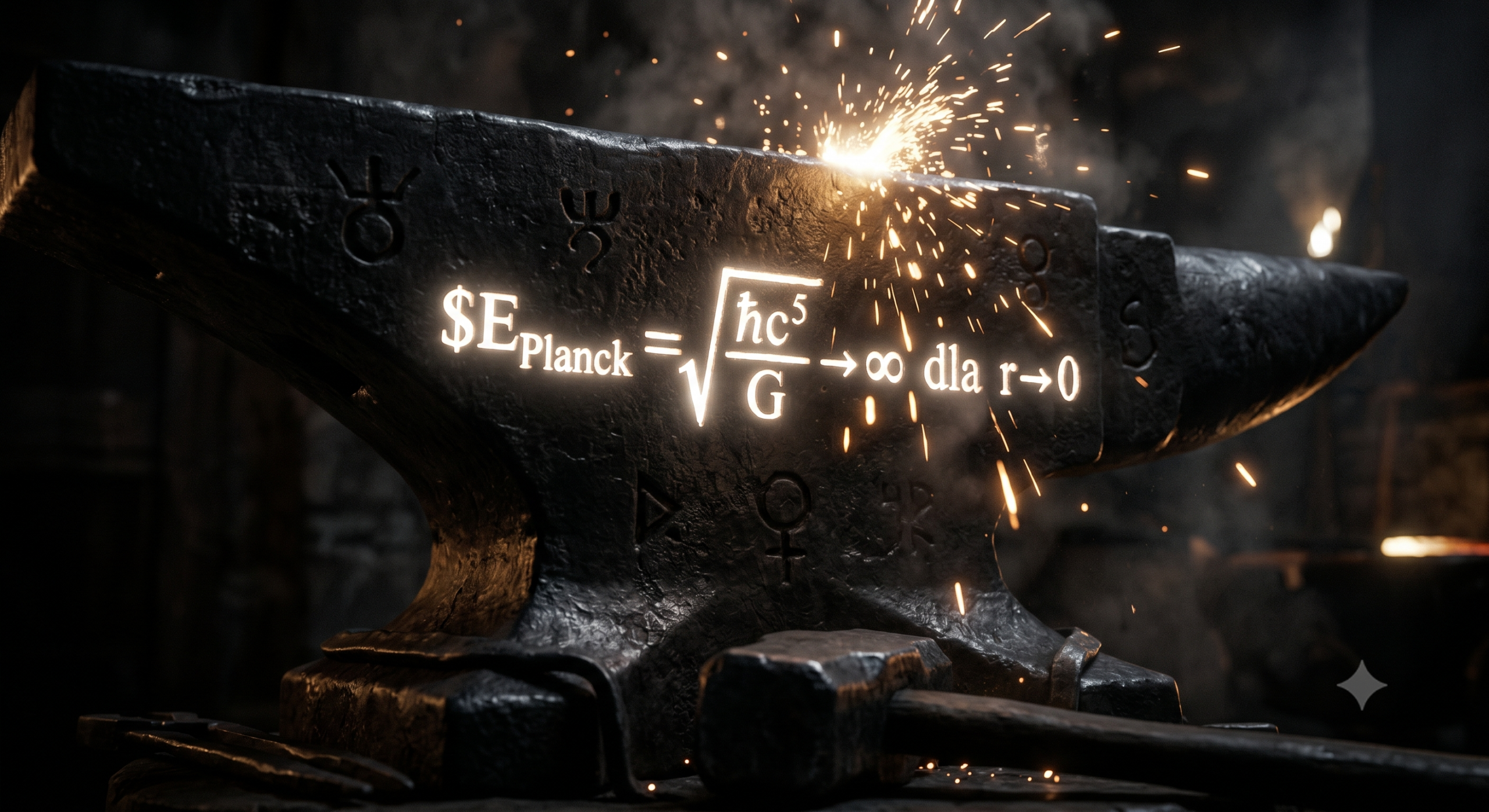
To prove his truth and show the terrifying end of the continuous world, Old Max walked up to the grand iron anvil standing in the center of the forge. He took a heavy steel punch in his hand and began to strike the metal with fury, engraving powerful, deep symbols onto its surface. When he finished, he summoned all the apprentices and blacksmiths to behold the stark, absolute formula of the micro-world—the Rune of the Exploding Spark:
A silence fell over the forge so deep that only the distant howl of the wind in the tectonic fissures could be heard. The blacksmiths stared at the gleaming runes etched in steel, and Max began to explain the dark anatomy of this ultimate warning.
“Look at the first ruler of this equation, on the left side,” Max began, pointing to the symbol $E_{Planck}$. “This is the Energy of the Supreme Fire. It is the force that slumbers within a single, minimal cell of reality when you try to compress it to its absolute limits. It is an indicator of how much power is unleashed when our rough spark attempts to defend its independence against your tailor’s cut.”
Next, he slid his finger over the powerful radical sign, beneath which lay hidden the intricate weave of the micro-world’s forces:
“At the very top of this fraction, in the numerator, we see an alliance of two extraordinary vacancies. The first is $\hbar$—the Seal of the Smallest Action, which is my quantum constant. It is the unalterable price of a single energetic beat, the size of a single bead of fire. Beside it stands the symbol $c^5$—the Fifth Breath of the Radiant Courier, which is the speed of light raised to the fifth power. This is a powerful, unimaginable speed at which an informational impulse attempts to race across the network to save the structure from collapse. These two symbols in the numerator represent the entire rebellion and resilience of the quantum world.”
Max paused, his voice dropping an octave as he pointed to the denominator of the fraction:
“And at the bottom, beneath the fraction line, dwells the solitary symbol $G$—the Weight of the Forefather of Attraction, which is Master Albi’s gravitational constant. It is the force that tries to draw everything into a single center, crushing and crushing matter without restraint. Do you see what is happening here? Your gravity $G$ is locked in a cage beneath the fraction line, forced to fight the power of quantum light from the numerator.”
Max raised his great hammer and struck the edge of the anvil, pointing to the arrow pointing to infinity on the right side:
“And now, look upon the final judgment that will kill you! If you believe the lie of continuity and allow the distance between your sparks—the radius $r$—to approach absolute zero ($r \rightarrow 0$), your denominator vanishes. The space beneath the knife shrinks to nothingness. And when the distance reaches zero, this entire fractional construct explodes! The energy $E_{Planck}$ ruthlessly approaches infinity ($\rightarrow \infty$)! The smallest point of your smooth world begins to weigh as much as the entire cosmos in a fraction of a second! Your entire continuous gravity suffers a total destruction!”
Chapter IV: The Fracturing of the World and the Monsters of Ultraviolet
The rune engraved by Max caused a true Catastrophe of Infinity in the Valley of Sparks. The blacksmiths, attempting to save their smooth models, tried to run mechanical simulations in which they summed the energy of all the small portions of fire on Albi’s continuous background. The results were terrifying. Because the background permitted the existence of infinitely small distances, billions of increasingly short, increasingly furious waves of violet and ultraviolet appeared in the calculations.
These microscopic waves refused to smooth out. On the contrary—each subsequent, shorter wave carried greater energy. In the traditional differential equations upon which the empire rested, the sum of all these small quantum fluctuations exploded to infinity. This was called the Ultraviolet Catastrophe.
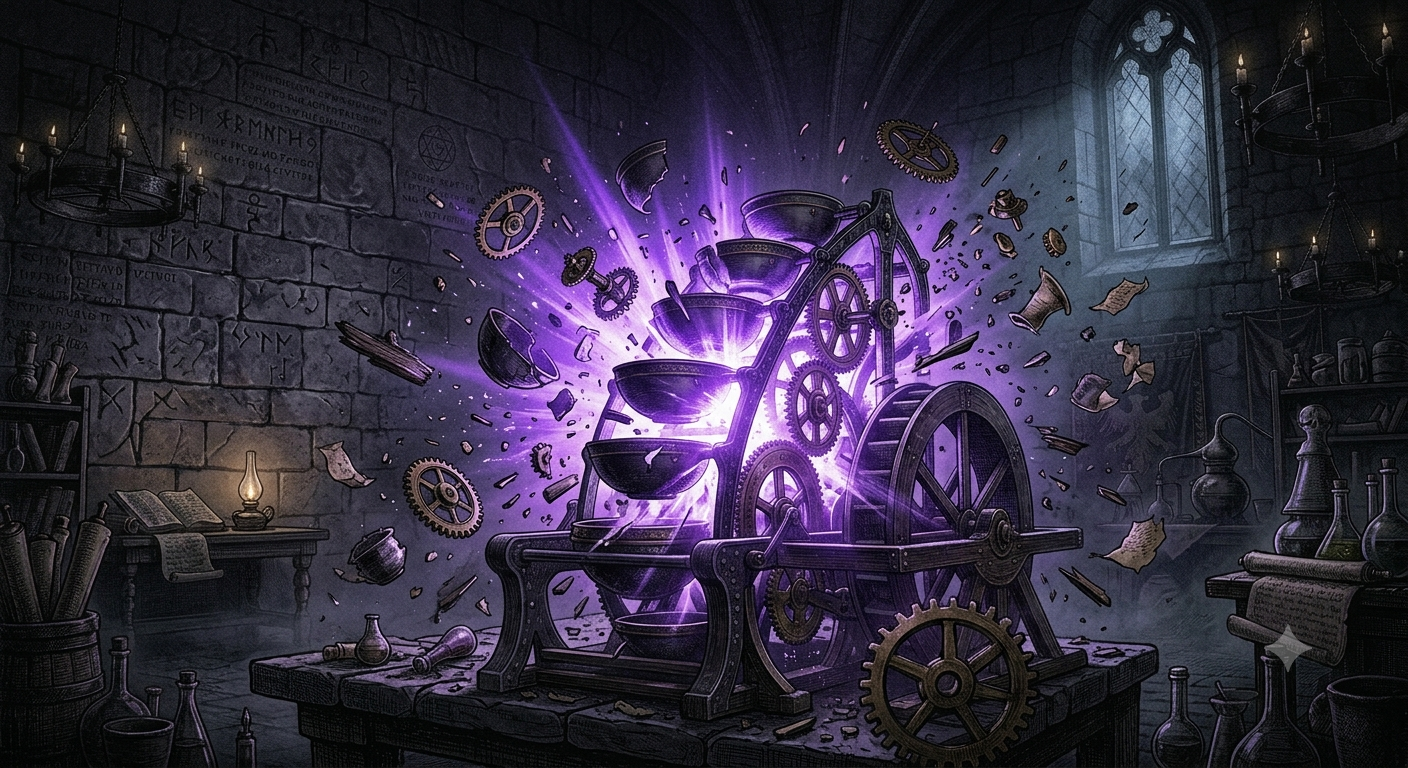
Most of the water-powered calculating machines were violently destroyed. Pipes burst under the pressure of non-physical force, and indicator dials spun endlessly, paralyzed by wild mathematical monsters. Every attempt to connect quantum fire with Einstein’s stable, smooth canvas ended in mathematical destruction. The world of continuum proved helpless: in the smallest scales, it generated a destructive division by zero that paralyzed equations and prevented a coherent unification of forces.
The blacksmiths sat before their ruined furnaces, holding their heads. Their cult of the infinitely sharp blade lay in ruins. They understood that if the distance between two events could approach absolute zero without hindrance, the energy of fields and the force of attraction would explode, destroying the geometric structure of reality. Continuity, which was supposed to be the pinnacle of elegance, turned into the worst nightmare in the micro-scale—an infinite wall through which no rational equation could breach.
Chapter V: The Bridge Across the Chasm of Zero
When despair in the Valley of Sparks reached its apogee, young Little Max entered the forge, holding in his hands a small clay tablet with the Manifesto of the Discrete Rebellion, which he had received from the rebels in the underground. He looked at the terrified blacksmiths, at the equation of Old Max engraved on the anvil, and at the broken calculating machines.
“Stop weeping over your broken toys,” said Little Max, and his voice brought a long-awaited peace. “This catastrophe you have just experienced is not the end of physics. It is merely the final burial of the lie of infinite divisibility.”
He walked over to Yashka’s tablet, upon which the structure of the first macroscopic trial still gleamed, and placed it beside the iron anvil.
“See how perfectly these two crises interlock,” Little Max explained. “Above, in the cosmos, Yashka proved that matter flees from voids because space has a cellular structure. Here, at the very bottom of smallness, the Rune of the Exploding Spark shows us that energy explodes only because you allow the distance $r$ to approach zero. But zero does not exist!”
He struck his hand against the Rune of the Global Weave:
“Within our Evolutionary Graph of Relations, the distance between two vertices is not a continuous coordinate that can be zero. The smallest possible distance is simply a single, solitary edge—one thread of the weave whose length is exactly $l_{Planck}$ (the minimal Planck scale). You cannot get closer than the distance of a single network connection! The network thread cannot be shorter than itself.”
When the blacksmiths heard these words, a gleam reappeared in their eyes, but this time it was not a blind faith in smoothness, but a rigorous delight at the finiteness of the network.
“If the distance $r$ never reaches zero,” Little Max continued, “if it is halted at the hard threshold of a single edge $l_{Planck}$, your denominator will never vanish! The energy $E_{Planck}$ will remain finite, and the monsters of ultraviolet will vanish in a fraction of a second. Our network of relations acts as a hard, geometric protective barrier that saves nature from your own mathematical greed for infinity.”
The First Trial of the Cosmos was fully closed and unified. Both in the macro-scale (through Yashka’s cellular foam) and in the micro-scale (through Max’s quantum scale-cutoff), Albi’s smooth Cloak had to give way to the raw, discrete structure of the graph. The substrate was defined—reality was an evolving collection of informational nodes.
“We are ready,” announced Little Max, packing his tools into his bag. “The architecture of the substrate has been secured. We have understood what the world is sewn from. It is time to set out on the path toward the Second Trial of the Cosmos—toward Row Two, where the Metric of Geometry awaits us on the battlefields, to once and for all strip the continuous tensors of old Bernie of their power.”